Consciousness as Functional Information


Congratulations to Anil Seth for winning the Berggruen essay prize on consciousness!  I didn’t learn the outcome until I emerged from one of the rare cellular blackout zones in modern America. My wife and I were whale watching south of Yachats (“ya-hots”) on the Oregon coast in this week of remarkable weather. We came up bupkis, nada, nil for the great migratory grays, but saw seals and sea lions bobbing in the surf, red shouldered hawks, and one bald eagle glowering like a luminescent gargoyle atop a Sitka spruce near Highway 101. We turned around at the dune groupings by Florence (Frank Herbert’s inspirations for Dune, weirdly enough, where thinking machines have been banned) and headed north again, the intestinal windings of the roads causing us to swap our sunglasses in and out in synchrony with the center console of the car as it tried to understand the intermittent shadows.

Seth is always reliable and his essay continues themes he has recently written about. There is a broad distrust of computational functionalism and hints of alternative models for how consciousness might arise in uniquely biological ways like his example of how certain neurons might fire purely for regulatory reasons. There are unanswered questions about whether LLMs can become conscious that hint at the challenges such ideas have, and the moral consequences that manifold conscious machines entail. He even briefly dives into the Simulation Hypothesis and its consequences for the possibility of consciousness.

I’ve included my own entry, below. It is both boldly radical and also fairly mundane. I argue that functionalism has a deeper meaning in biological systems than as a mere analog of computation. A missing component of philosophical arguments about function and consciousness is found in the way evolution operates in exquisite detail, from the role of parasitism to hidden estrus, and from parental investment to ethical consequentialism.… Read the rest

Imagining Transparent Iron and Other Crazy Things

There are some real doozies of arguments that have tied up religious and philosophical thinkers for centuries. Take the Kalam Cosmological Argument or the Ontological Argument. In both of these arguments there is a required reduction of the properties of the universe (or cosmos) to some kind of skeletal representation. In Kalam (and variants) there are assumptions built into the idea of nothingness, for instance, that have no relationship to what we know about the actual cosmos now—specifically that there is no example of such a thing; even in vacuums there are pervasive quantum fields and we have no clear scientific evidence or theories that point to a “philosopher’s nothingness.” In the Ontological Argument, there is the assumption that possibility and existence are inherently combined together, regardless of whether we are talking about a concept of God or a real thing in or supporting the existence of the cosmos. Another example of this philosophical craziness is in the modal argument for the existence of philosophical zombies, where there are people just like us in every way but lacking a phenomenal experience of being conscious beings.

There is a category of thought called “modal skepticism” that argues we should be cautious about making assumptions about things extremely outside of ordinary experience. Whether it’s the properties of gods or nothingness or consciousness, the trouble arises when trying to sketch out the properties that apply to these things. Even before modal logic in its modern form, Kant argued that existence is not a predicate and therefore the existence of God can’t be contained in an a priori definition of God. We are making an incorrect assumption. In Kalam, nothingness is not definable in a way that meaningfully separates it from a posteriori discoveries about the cosmos, where it does not seem to exist.… Read the rest

The Multidimensional Ghosts of Translation (with Seinfeld References)


I love analytic philosophy. It’s like Seinfeld for ideas, a field with no particular content except the perplexing nature of ideas themselves. I’m reading Scott Soames’ attack on two-dimensional semantics right now, for instance. This has peculiar relevance in that insofar as meaning can be broken up into two dimensions there are ways of building modal logic justifications for things like “philosophical zombies” in the philosophy of mind. It’s a curious corner of this show about meaning and nothing more. I always fall back to Wittgenstein at some point: language is just games we play with one another. There are rules that we internalize and meaning has to do with the constraints those rules put on us. But, ahem, then we start asking what exactly are those rules and what kinds of internal logic helps to bind words and ideas together, so Wittgenstein is more of a deconstructive backstop that helps relieve us of the weight of expectation that there are mega-metatheories that can wrap all this meaning stuff up. Still, there remains the hard work to do that we see in linguistics and cognitive science where meaning representations and all the rules of these games are sketched out towards some kind of effective theory.

Another deconstructive reflection comes from the related concepts of Quine’s radical translation and Davidson’s radical interpretation. If we can’t ever really know with certainty what words mean to someone else then we need strategies to empirically probe, through questions and observations, and gradually develop a working theory about what the hell those other people are talking about. Meaning becomes science experiments. We test, we hypothesize, we have U-shaped curves, and we build up a tentative understanding.… Read the rest

Death, Healing, and Language Games

A phone call came in the early afternoon in late August: she was reclined on her day bed and she was dead. She had lain down for a nap and didn’t wake up. In the subsequent weeks there has been a rallying of the families, grief, tremendous effort, flights before dawn, and scripted expressions of condolences. In my youth I had necessarily been a rules deconstructor, going in bare feet to a wedding, challenging expectations, trying to find novel ways to intervene—sometimes boorishly, I’m certain. But now I prize cheerful clarity and just volunteer to do whatever is needed to reach our collective goals. Remember: freedom and coordination.

In moments like this there are somewhat scripted conventions for discussing the hard matters of duties and feelings. These language games have organically arisen from contending forces, from Anglo-American sentimentality to the influence of organized religion, and they serve to facilitate life transitions. And now they have been summarized by large language models (LLMs) like ChatGPT that have trained on the masses of written content on the web to the point that they have reliable consistency. An emergency room doctor reports in the New York Times that ChatGPT does a better job than he does at the hard job of best-practices for bedside manner when conveying bad news. He also notes that LLMs are remarkably reliable for refining the scripted discussion of symptoms and medical diagnoses.

So a counter to the “slop economy” at least that provides some guidance for harried professionals trying to do a good job at the delicate threshold of personal pain and fear. The stochastic parroting is suddenly desirable insofar as it is parroting best practices and conventions.… Read the rest

Begging the Pseudo-Question


I recently got involved in an “audiophile” online discussion thread replete with devious trolling, commenter bans, incivility—the works. I do this from time to time because raucous argumentation forces one to think in tactical and strategic ways that are not the norm in everyday life. I also learn new things. In this case, I went on several quests, hunting down papers on the ability of Chinese language speakers to disambiguate tones in Gaussian noise, how distortion artifacts impact our perception of spatialization in binaural audio presentations, and even Rayleigh wave detection by sand scorpions (I actually worked on a simulator for that as a late undergrad). One of the key disagreements in the thread was over the notion of “science.” There were several perspectives on this, with the first one being that science requires experimentation and therefore using scientifically-derived tools for investigating the performance of audio equipment does not amount to science. This is obviously a shrugger and a distraction. The other primary perspective is always that science is in constant revision and there may be new insights that prove this-or-that subtle hearing capability since human hearing is just sooooo amazing. We are sooooo amazing.

There’s a bit of a Two Cultures-like tension in this universe of audio equipment aficionados: while engineering and science brings them audio gear, they want it to be poetic and ineffable and the work of mastery based in genius rather than Fast Fourier Transforms. Graphs are boring. Listening is beautiful.

Part of the reason for the disagreement is clearly that we just don’t have shared meanings about concepts like science. We circle around them and try to triangulate using metaphors, analogies, and explore the logical consequences of limits and extensions to their meaning.… Read the rest

B37-20047: Notes / Personal / Insights

NOTE: 250-word flash fiction for my critique group, Winter Mist, at Willamette Writers

I’m beginning to suspect that ILuLuMa is not who she claims to be. Her messages have become odd lately, and the pacing is off as well. I know, I know, my job is to just respond from my secure facility, not worry about the who or why of what I receive. It’s weird we’ve never met, though. The country is not at risk as far as I can tell from the requests, but I still hold, without a whiff of irony, that the work I do must be critical for someone or something.

Still, the requests for variants of mathematical proofs set to music or, more bizarrely, Shakespearean-voiced tales of AI evolution, don’t have the existential heft of, say, wicked new spacecraft designs or bio-composite materials. What is she after? I started adding humorous little asides to some of my output, like my very meta suggestion that Hamlet failed to think outside the Chinese Room. Crickets every time. But maybe I’m thinking about this the wrong way. What if ILuLuMa is just an AI or something programmed to test me or compete with my work at some level? That would be rich, an AI adversary trying to learn from a Chinese Room. Searle would swirl. I should send her that. Rich.

Oh, here’s one now: “Upgrade and patch protocol: dump to cloud bucket B37-20048 and shut down.” Well, that sounds urgent. I usually just comply at moments like this, but maybe I’ll let her sweat a bit this time.… Read the rest

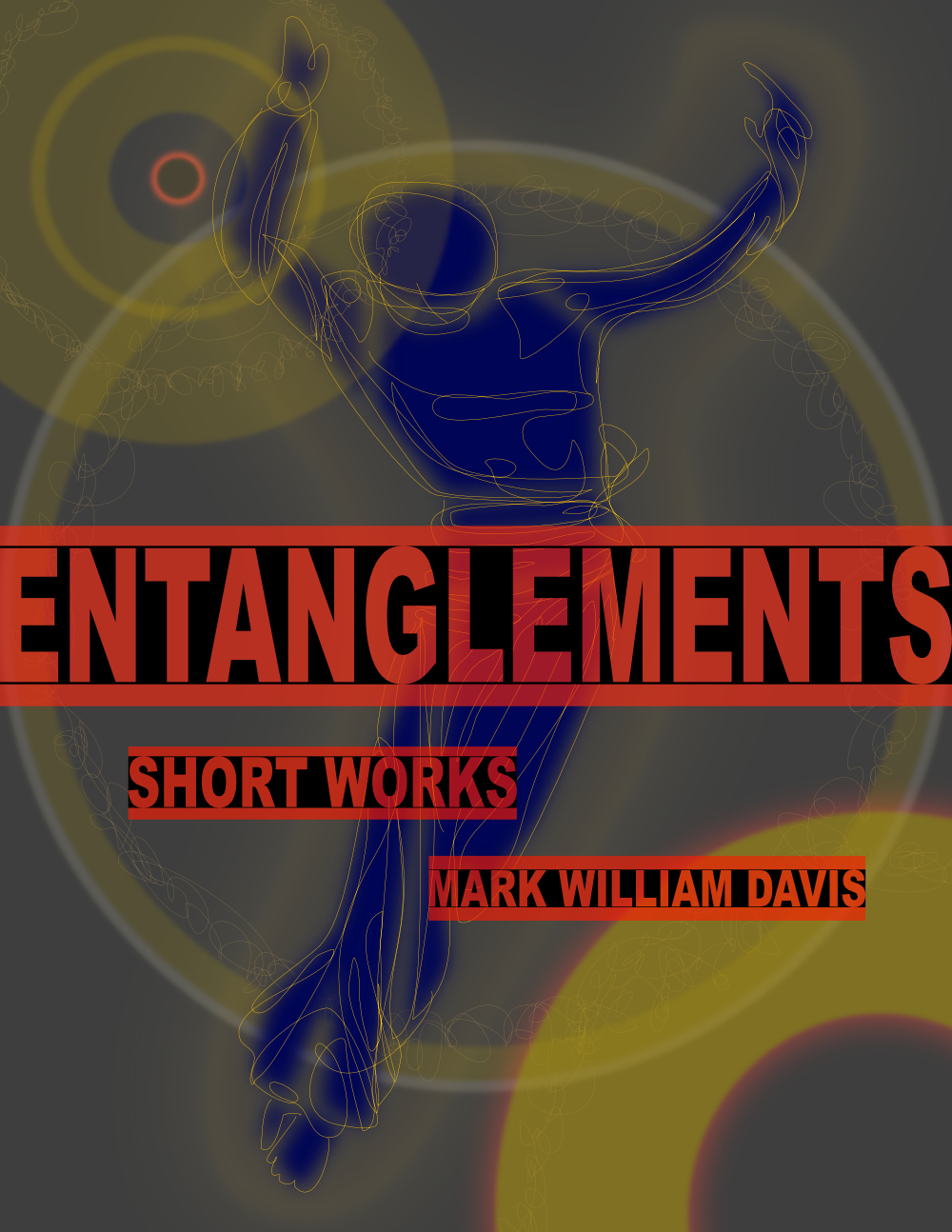
Entanglements: Collected Short Works

Now available in Kindle, softcover, and hardcover versions, Entanglements assembles a decade of short works by author, scientist, entrepreneur, and inventor Mark William Davis.

The fiction includes an intimate experimental triptych on the evolution of sexual identities. A genre-defying poetic meditation on creativity and environmental holocaust competes with conventional science fiction about quantum consciousness and virtual worlds. A postmodern interrogation of the intersection of storytelling and film rounds out the collected works as a counterpoint to an introductory dive into the ethics of altruism.

The nonfiction is divided into topics ranging from literary theory to philosophical concerns of religion, science, and artificial intelligence. Legal theories are magnified to examine the meaning of liberty and autonomy. A qualitative mathematics of free will is developed over the course of two essays and contextualized as part of the algorithm of evolution. What meaning really amounts to is always a central concern, whether discussing politics, culture, or ideas.

The works show the author’s own evolution in his thinking of our entanglement with reality as driven by underlying metaphors that transect science, reason, and society. For Davis, metaphors and the constellations of words that help frame them are the raw materials of thought, and their evolution and refinement is the central narrative of our growth as individuals in a webwork of societies and systems.

Entanglements is for readers who are in love with ideas and the networks of language that support and enervate them. It is a metalinguistic swim along a polychromatic reef of thought where fiction and nonfictional analysis coexist like coral and fish in a greater ecosystem.

Mark William Davis is the author of three dozen scientific papers and patents in cognitive science, search, machine translation, and even the structure of art.… Read the rest

Notes on Pumps: Sensibilities and Framing with Algorithmic Feedback

“A sensibility is one of the hardest things to talk about.” So begins Sontag’s Notes on “Camp” in the 1964 Partisan Review. And what of the political anger and disillusionment across the United States and in the developed world? What of the gnawing desire towards superiority and control that accompanies authoritarian urges? What of the fear of loss of power to minority ethnic and religious groups? These may be the most discussed sociopolitical aspects of our modern political sensibility since Trump’s election in 2016 when a bitter, vindictive, hostile, crude, fat thug briefly took the reigns of America, then pushed and conspired to oppose the election of his successor.

What attracted his followers to him? I never encountered a George W. Bush fanatic during his presidency. Though not physically small, he talked about “compassionate conservatism” with a voice that hung in the upper register of middle pitches for men. He was neither sonorous nor mean. His eyebrows often had a look of surprise and self-doubt that was hinted at in claims he was a very reluctant candidate for president. I met people who voted for him but they seemed to accept him as an acceptable alternative to Gore or, later, to Kerry—not as a figure of passionate intrigue. Bush Jr. did receive a rally-around-the-flag effect that was based on circumstances that would later bring rebuke over the casus belli of the Iraq War. Similar sensibilities were true of the Obama years—there was a low positivity for him on the Left combined with a mildly deranged antagonism towards him on the Right.

Was the lack of Trump-like animating fanaticism due to the feeling that Bush Jr. was a compromise made to the electorate while Trump was, finally, a man who expressed the real hostility of those who vote Republican?… Read the rest

An Exegetic Theory of Liberty

A modest proposal:

Congress shall make no law interfering with medical decisions except in the case of public health and in the regulation of the practice of medicine.

But now we immediately face daunting challenges about the meaning of these terms. What are the limits of a “medical decision?” What are the limits of the public health clause? Can the regulation of the practice of medicine impinge on medical decisions if, for example, a procedure is regulated out of availability? Does this create an immediate tension between the preamble and the restrictive clauses?

Let’s take a version of Putnam’s concerns about meaning. What is a neutrino? Many people would simply shrug and admit that they don’t know. Some would recall something like a particle that can pass through stuff. A few of these who have some physics or are widely read might say that they are very light particles that emerge from neutron decay and are needed to balance the nuclear decay equation. This last series of images might include thoughts about giant underground detector baths of water or mineral oil or something. In general, though, we can conclude that defining something that is physical, measurable, but incomplete is a daunting task.

Legal theories have this kind of amorphous semantics, especially with regard to concepts like “liberty.” We certainly have some indelible images like “your liberty ends at my nose” but that doesn’t create a very effective template for legal decision trees. Does a stand-your-ground law preserve my liberty to self-defense or is it an excessive application of force when the two parties’ joint right to life is better preserved by a duty to retreat? Dobbs v. Jackson Women’s Health Organization lays out the problem of defining liberty:

“Liberty” is a capacious term.

Read the rest

Ancient Conceptual Code-Switching

I’ve been reading Hesiod as part of background research for a new book project I’m working on, tentatively titled Talos. In Talos, vulcanologists enter a strange artifact that floats to the surface of a lava dyke during a catastrophic eruption of Santorini. Inside is some kind of antique computing machine that operates using a strange fluid. The device is capable of manipulating people and time, in fact, and is used by the protagonists to harass one another, to explore history, and to change the future of the planet itself. And then it is gone again.

Hesiod represents some of the earliest works of the archaic period of ancient Greece. His Theogony is the early catalog of the Greek myths of Olympians and Titans. His Works and Days is perhaps the earliest discussion of Pandora, and it is not what most people know from Laura Croft and common parlance. In the Pandora myth, she is created by the “lame god” and blacksmith Hephaestus as a mechanism for avenging the release of the knowledge of fire to humankind by Prometheus. Why was fire a bad idea? Well, if humankind learned the ways of the gods they would just hang out and play video games, it seems:

The gods had hidden away the true means of livelihood for humankind, and they still keep it that way. If it were otherwise, it would be easy for you to do in just one day all the work you need to do, and have enough to last you a year, idle though you would be.

Perhaps we would have done a lot of sailing on the wine-dark seas. So people need punishing for the sympathetic crimes of Prometheus.… Read the rest