Limits for the Unlimited Mind

I’ve had a longer-than-usual hiatus from posting due to adding a new living arrangement to our small collection. Acquiring and moving furniture, appliances, toiletries, bedding, audio equipment, and cleaning supplies between spaces has an almost unlimited ability to distract. And when a quiet final settles in, there remains a restlessness about optimizing experiences and priorities that takes time to psychically draw down. It’s the clattering opposite of focusmaxxing. On the positive, new places constantly reset and tune expectations about what is important and what matters little in a life, with people, ideas, and new experiences always rising above the glimmer of these damn possessions.

This rich inner life, this sense of a self that powers the great religions and mystical traditions of the world, this atman and soul, these ideas of impermanence, justice, and wonder—can they all be a product of a versatile connective matrix that computes these optimizing decisions while simultaneously creating a vital subjective sense of identity? There is a theory called unlimited associational learning (UAL) that posits exactly that. Our adaptation to the world is one of temporal superiority. A plan and a reaction for a conscience entity is a function for pulling time apart and predicting the future, from the cause-effect of seasonal migrations of herd animals to estimating the supportive and defensive capabilities of mates.

The essential hinge is that this consciousness, this sense of being someone, must on average be more effective than the other trajectories through the phylogenetic, epigenetic, and ontogenetic state spaces. And that’s even with all the flaws like misperceptions, biases, neurological injuries, and schizophrenia. Proving this with any sort of mathematical precision has an almost impossible bar to meet since it would require that a model first is shown to be conscious with the set of UAL-sufficient hallmarks, like global accessibility, integration over time, agency and embodiment, and so on.… Read the rest

Consciousness as Functional Information


Congratulations to Anil Seth for winning the Berggruen essay prize on consciousness!  I didn’t learn the outcome until I emerged from one of the rare cellular blackout zones in modern America. My wife and I were whale watching south of Yachats (“ya-hots”) on the Oregon coast in this week of remarkable weather. We came up bupkis, nada, nil for the great migratory grays, but saw seals and sea lions bobbing in the surf, red shouldered hawks, and one bald eagle glowering like a luminescent gargoyle atop a Sitka spruce near Highway 101. We turned around at the dune groupings by Florence (Frank Herbert’s inspirations for Dune, weirdly enough, where thinking machines have been banned) and headed north again, the intestinal windings of the roads causing us to swap our sunglasses in and out in synchrony with the center console of the car as it tried to understand the intermittent shadows.

Seth is always reliable and his essay continues themes he has recently written about. There is a broad distrust of computational functionalism and hints of alternative models for how consciousness might arise in uniquely biological ways like his example of how certain neurons might fire purely for regulatory reasons. There are unanswered questions about whether LLMs can become conscious that hint at the challenges such ideas have, and the moral consequences that manifold conscious machines entail. He even briefly dives into the Simulation Hypothesis and its consequences for the possibility of consciousness.

I’ve included my own entry, below. It is both boldly radical and also fairly mundane. I argue that functionalism has a deeper meaning in biological systems than as a mere analog of computation. A missing component of philosophical arguments about function and consciousness is found in the way evolution operates in exquisite detail, from the role of parasitism to hidden estrus, and from parental investment to ethical consequentialism.… Read the rest

Wordle and the Hard Problem of Philosophy

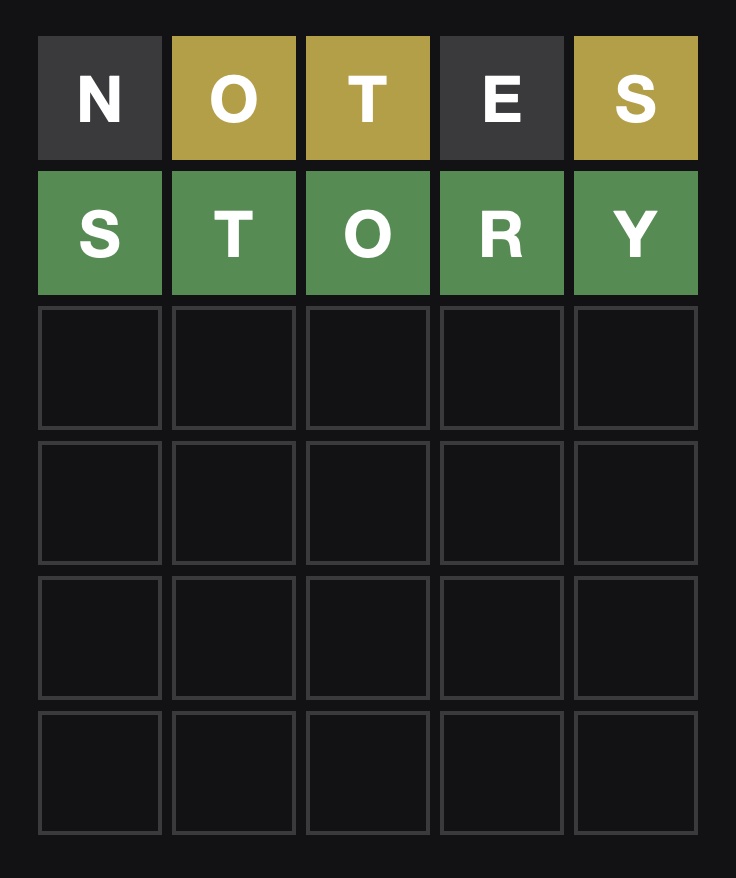
I occasionally do Wordles at the New York Times. If you are not familiar, the game is very simple. You have six chances to guess a five-letter word. When you make a guess, letters that are in the correct position turn green. Letters that are in the word but in the wrong position turn yellow. The mental process for solving them is best optimized by choosing a word initially that has high-frequency English letters, like “notes,” and then proceeding from there. At some point in the guessing process, one is confronted with anchoring known letters and trying to remember words that might fit the sequence. There is a handy virtual keyboard displayed below the word matrix that shows you the letters in black, yellow, green, and gray that you have tried, that are required, that are fit to position, and that remain untested, respectively. After a bit, you start to apply little algorithms and exclusionary rules to the process: What if I anchor an S at the beginning? There are no five-letter words that end in “yi” in English, etc. There is a feeling of working through these mental strategies and even a feeling of green and yellow as signposts along the way.

I decided this morning to write the simplest one-line Wordle helper I could and solved the puzzle in two guesses:

Sorry for the spoiler if you haven’t gotten to it yet! Here’s what I needed to do the job: a five letter word list for English and a word frequency list for English. I could have derived the first from the second but found the first first, here. The second required I log into Kaggle to get a good CSV searchable list.… Read the rest