Civilization, Erasure, and Immaculate Conceptions

Jeff Koons’ Venus figure from Barcelona’s MOCO Museum. You can see me with my phone trapped in her belly.

There is a persistent fear of societal erasure that permeates contemporary social and cultural criticism. South Korea, Taiwan, Italy, and Eastern Europe all have very low birthrates and face the reality of drastic change or erasure in the next fifty or so years. Even the leaden National Security Strategy (NSS) document of the Trump administration outright proclaims there is a “stark prospect of civilizational erasure” in Europe due to low birthrates and immigration. In the United States there is worry over young people not being interested in sex, and birthrates, while not as low as in other countries, have not been at replacement rate for more than a decade. Among working-class whites in America, young women often just find their male counterparts not good husband or father material. The same is true of college-educated women, who increasingly outnumber their slacker male counterparts

Some commentators reflect that what is needed is a religious revival that somehow reverses the liberation of women and gets them back to raising children in a celebration of God’s aims. Less dreamy policy ideas include paying couples for children and eliminating the economic barriers to working women who have children.

There is, of course, an inherent racism built into some of these fears; the thought is that American or Japan or Italy are losing something important if waves of immigrants gradually come to dominate the civilizations. The decline and fall of Western civilization is driven not by the LA punk scene but by this nebulous replacement idea driven by some kind of global elite (often with antisemitic overtones).… Read the rest

Against Nostalgia


Some conservatives carry on even as the bizarro world continues to invert reality on Trump’s watch. Over at National Review they are kvetching about state and local regulations for hair stylists. Damn, look at the market distortions! If only we could unlock that 1/2 of 1/10th of a percent of the market we would achieve libertarian liberation! Meanwhile, Donald Trump is taking an ownership stake in Intel and imposing export tariffs on Nvidia like a socialist dictator. And David Brooks at New York Times proclaims that cultural factors override the role of money in terms of making or breaking the success of people. If only we were more…Swedish we would not have to descend into nihilistic doom cycles.

It’s not that these aren’t partially true, of course, but merely that they are shadow-boxing on an old battlefield filled with muskets and cannonballs. The new war has moved on.

This inverted reality calls for something different. The notion that we can reclaim social stability through nostalgia or micro-microeconomics lacks sensibility, credibility, and honesty. We live in a modern world where even core concepts like the reliability of the Gospels is widely distrusted, which in part explains the increasing view of Christian institutions as centers of manipulation and cruelty. There never was any there there, just shadowy programming and ignorance before the internet era. Get them young enough and they can be groomed, like Epstein’s victims. The critical role of culture and institutions was always as fragile as the communications and information systems that supported it. Now there is nothing but the dark potential of power.

And here I am, so negative! And just after inventing my own religion built around trust and optimizing our personal and group engagement with the state and the world.… Read the rest

The Hard Problem of the Future

The American zeitgeist is obsessed with decline and a curious sense of ennui. On the progressive left there is the rolling mortal threat of inequality and the destruction of the middle class. Wages don’t keep up with inflation or, more broadly, the cost of living. On the new MAGA right there is an unfocused rage that builds in part on the angst of hollowed-out rural and post-industrial communities, and then in part on undocumented immigrants as scapegoats and symbolic of lefty lawlessness, and again in part as a tirade against wealthy, coastal elites who control the media, universities, and have pushed the Overton window in incremental lurches towards inclusiveness. The populism is mostly half-baked, certainly, and exploited by cynical conservatives for undermining social support while bolstering commercial interests and reducing taxes for the well-to-do. But half-baked is enough for a sensibility; things fully realized are only afterthoughts.

There are other chthonic rumblings and imputations that filter up. The rise of China’s industrial, military, and scientific power is a growing shadow that some see threatening to engulf the world in its umbra. And with it comes the fear of slowing technological might, despite the domination of the recent technological present by the United States. We might be left behind like unhoused, opioid-addicted, modern peasants. The crumbling of the cities would be just punishment even if their loss only cascades the problems of the heartland.

And so as the future keeps getting harder, we turn to mad kings who promise radical change in the face of hard problems. The change can’t possibly be realized, so it is better to just pretend that there are solutions. Annex Greenland, rename the Gulf of Mexico, incorporate Canada, occupy Panama, reach for Mars, acquire territory, but all the while cocooned by the complex institutional and international realities that mean that acting aggressively and alone is now untenable.… Read the rest

Studying for Exceptionalism

Caustic modern American politics has arisen in the new metaverse of communications technologies. Everyone has an opinion and shares it. This perhaps leads to pervasive unhappiness with any kind of governance. There’s always something to bitch about because real change is both hard and always has winners and losers of some sort. But what do the happiest countries in the world do differently than those of us in the second and lower tiers? Worth reading is the seventh chapter of the World Happiness Report titled “The Nordic Exceptionalism.” Finland, Denmark, Sweden, Iceland, and Norway are all at the top, along with Switzerland, New Zealand, and Austria. And what do these countries do right that makes them so exceptional in terms of happiness? Well, it’s not due to some of the suggested culprits like low immigrant rates and cultural uniformity or high rates of suicide culling out the unhappy. It’s also not clearly due to lower levels of income inequality compared with peer countries. The effect of inequality on happiness appears to correlate with GDP per capita and is reduced in impact by the presence of a generous welfare state; it contributes but is not central.

Instead, important factors include trust in social institutions and low rates of corruption. People in these countries also feel freer than in peer countries, including the United States. Their overall life satisfaction levels are very high and have much lower variation within the populace than countries like ours, as well. Part of the sense of freedom may arise from the generosity of the welfare states by reducing the risk of exploring life options, which is also a side-effect of wealth in these countries.

A dive into potential root causes reveals some surprises, like:

Another important underlying factor might have been mass education.

Read the rest

An Ancient Mind Plague

In addition to Cormac McCarthy, Milan Kundera died this summer after a remarkable run of 94 years. I first read The Unbearable Lightness of Being in the early 90s and loved the strange detachment of the narrator and small moments like the critique of muzak in restaurant settings (I am now much more critical of restaurants that poorly manage sound reflections; how am I to enjoy my company in a cacophony?) But I had little use for his central philosophical pretense concerning eternal return or the use of metaphors as placeholders for people, though I have known people who strain to operate that way. Structuring a narrative around flimsy Continental ideas from Nietzsche, in turn influenced by Hinduism, Buddhism, and even Pythagoras, was too conspicuously self-absorbed with an intellectual airiness. It’s easy to achieve pretension but quite another thing to convey lofty thoughts effortlessly. I might have accepted a narrator musing on the topic among many others, playing with it while laughing at his own ridiculousness, and concluding that such concepts were mythological at best.

But there is a certain circularity in that otherwise educated people continue to latch onto narratives and metaphors that are appealing and unexpectedly strange, from little dioramas about the motives of people in our lives to grand conspiracies and mythologies filled with resurrections, demons, and eschatologies. The conspiracy narratives are a special contemporary problem accelerated by modern communications technologies, but there is nothing particularly new about them in thrust, focus, or pervasiveness.

Aluminum cans cause Alzheimer’s disease? Procter and Gamble’s logo was satanic? When I was in the Peace Corps in Fiji, the Hindu kids thought that certain toothpastes from Australia were adulterated with cow fat or something to undermine Hinduism.… Read the rest

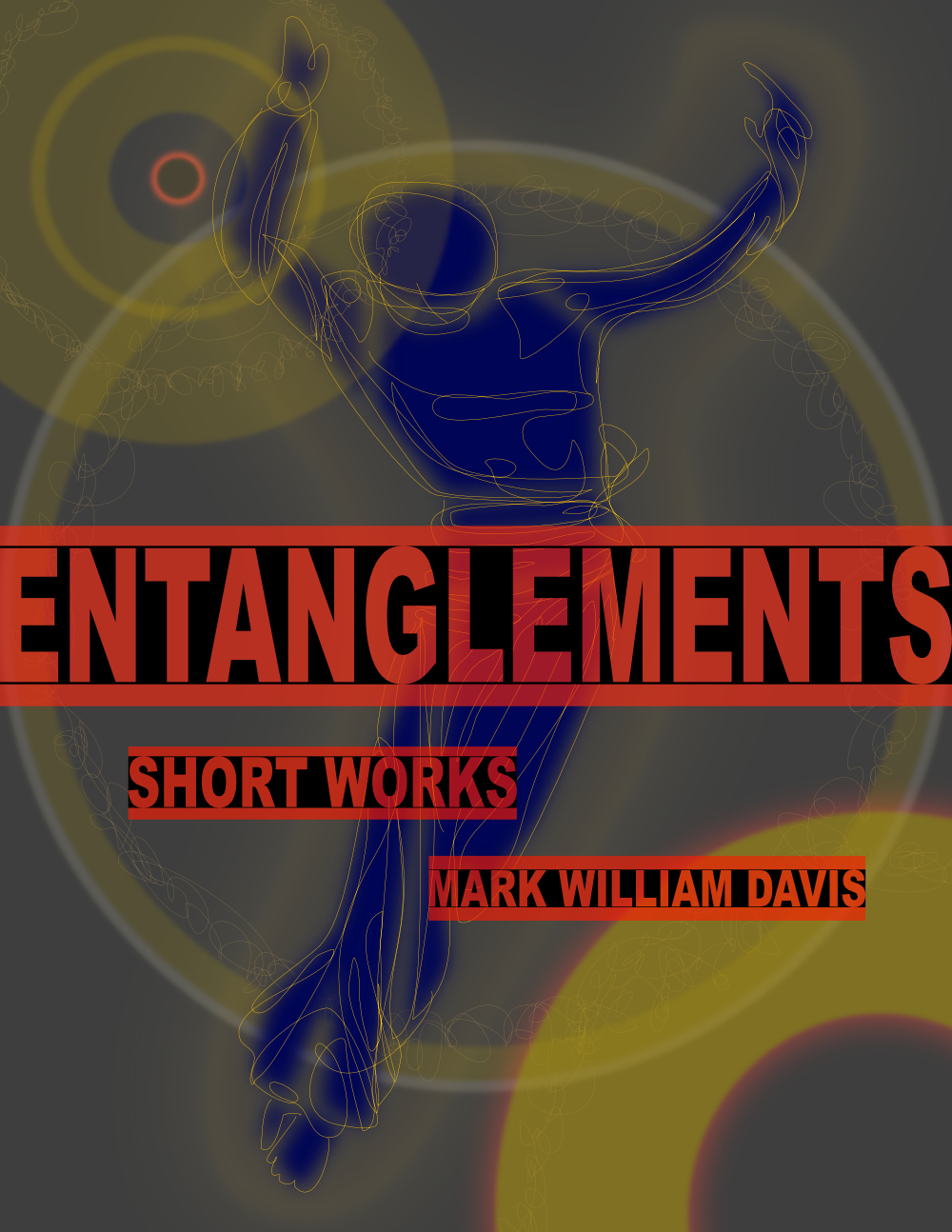
Entanglements: Collected Short Works

Now available in Kindle, softcover, and hardcover versions, Entanglements assembles a decade of short works by author, scientist, entrepreneur, and inventor Mark William Davis.

The fiction includes an intimate experimental triptych on the evolution of sexual identities. A genre-defying poetic meditation on creativity and environmental holocaust competes with conventional science fiction about quantum consciousness and virtual worlds. A postmodern interrogation of the intersection of storytelling and film rounds out the collected works as a counterpoint to an introductory dive into the ethics of altruism.

The nonfiction is divided into topics ranging from literary theory to philosophical concerns of religion, science, and artificial intelligence. Legal theories are magnified to examine the meaning of liberty and autonomy. A qualitative mathematics of free will is developed over the course of two essays and contextualized as part of the algorithm of evolution. What meaning really amounts to is always a central concern, whether discussing politics, culture, or ideas.

The works show the author’s own evolution in his thinking of our entanglement with reality as driven by underlying metaphors that transect science, reason, and society. For Davis, metaphors and the constellations of words that help frame them are the raw materials of thought, and their evolution and refinement is the central narrative of our growth as individuals in a webwork of societies and systems.

Entanglements is for readers who are in love with ideas and the networks of language that support and enervate them. It is a metalinguistic swim along a polychromatic reef of thought where fiction and nonfictional analysis coexist like coral and fish in a greater ecosystem.

Mark William Davis is the author of three dozen scientific papers and patents in cognitive science, search, machine translation, and even the structure of art.… Read the rest

Notes on Pumps: Sensibilities and Framing with Algorithmic Feedback

“A sensibility is one of the hardest things to talk about.” So begins Sontag’s Notes on “Camp” in the 1964 Partisan Review. And what of the political anger and disillusionment across the United States and in the developed world? What of the gnawing desire towards superiority and control that accompanies authoritarian urges? What of the fear of loss of power to minority ethnic and religious groups? These may be the most discussed sociopolitical aspects of our modern political sensibility since Trump’s election in 2016 when a bitter, vindictive, hostile, crude, fat thug briefly took the reigns of America, then pushed and conspired to oppose the election of his successor.

What attracted his followers to him? I never encountered a George W. Bush fanatic during his presidency. Though not physically small, he talked about “compassionate conservatism” with a voice that hung in the upper register of middle pitches for men. He was neither sonorous nor mean. His eyebrows often had a look of surprise and self-doubt that was hinted at in claims he was a very reluctant candidate for president. I met people who voted for him but they seemed to accept him as an acceptable alternative to Gore or, later, to Kerry—not as a figure of passionate intrigue. Bush Jr. did receive a rally-around-the-flag effect that was based on circumstances that would later bring rebuke over the casus belli of the Iraq War. Similar sensibilities were true of the Obama years—there was a low positivity for him on the Left combined with a mildly deranged antagonism towards him on the Right.

Was the lack of Trump-like animating fanaticism due to the feeling that Bush Jr. was a compromise made to the electorate while Trump was, finally, a man who expressed the real hostility of those who vote Republican?… Read the rest

Intellectual Capital, Religion, Audiofools, and Irrational Poynting Vectors

Twin New York-associated articles of note today. First, we have the New York Times with Ilana Horwitz of Tulane University on the topic of how religion helps working-class young people—especially boys—to better achieve after high school. This is part of the ongoing saga of better understanding the sagging social support network (“social capital”) that has been suggested to explain high rates of despair, opioid addiction, alcohol abuse, suicide, and even white supremacist ideation and Trumpism among working-class Americans. What is particularly interesting to me is that the same religious enhancement of educational attainment doesn’t apply to the children of college-educated professionals and the author notes that strong religious belief systems—especially among young women—may interfere with future decision-making by directing them towards traditional female careers and roles.

Meanwhile, Cornel West has a wide-ranging interview in The New Yorker where he repeatedly decries Harvard for becoming a spiritual wasteland of sorts, dedicated to the education of a professional-managerial class that lacks some elemental soul needed to translate ideas into public intellectual and social engagement:

That’s not just brother Trump, even though he’s a neo-Fascist one. He’s on the continuum with so much of the professional-managerial class in terms of their lack of accountability to working people and poor people. Once you have that kind of spiritual decay and moral decrepitude, man, then it’s just gangsterization on steroids, man. That’s where America’s headed.

So it seems many of the religious working-class college achievers are just working towards some kind of soulless professionalism. Without converting their intellectual achievements into activism, and by just focusing on jobs and further achievement, they are content to let the backslide towards authoritarianism continue apace. West sees a neoliberal hypocrisy at every turn, as well, and almost as toxic as the fascist urge.… Read the rest

Consequentia Roquentia

I just invented a new Voltairian muse for consideration. Dr. Roquentia, after Sartre’s lead in Nausea, is the opposite of Dr. Pangloss, convinced that we are in a state of perpetual, inevitable decline. Dr. R. is unmoved by evidence to the contrary concerning improvements in society because he can always sense unease and emptiness in this change.

I thought of the good doctor not while reading the boorish WSJ hit piece on Jill Biden for being labeled “Dr.” because she has only a PhD rather than an MD. It’s an acceptable editorial convention, but hardly one that should be irritating enough to belittle the owner of the title. Dr. R. would lose the honorific, too, being merely an advanced student of the jeremiad in his own narcissistic pursuit of identity.

No, instead I thought of this new caricature while reading National Review to catch up on what is troubling one corner of the conservative mind here as Our Glorious Leader tries to subvert democracy. There are always unwritten assumptions in NR opinion pieces, as if the righteous world lurks just out of reach in the shadows. In this one, there is a quick slap for “intersectional” scholarship, or perhaps just how it might influence public discourse or policy. More centrally, though, the background zeitgeist is the assumption that it is a moral good for children to be raised to be religious like their parents, and that American society is diminished by the reduction in religiosity in America of late. Dr R, sensing a comfortable decline into misery, laments perhaps a bit too ironically given that the recovery from religionless nihilism was central to Nausea.

The author, Cameron Hildritch, might be surprised to learn that there is an alternative and less ideological way of regarding secularized education.… Read the rest

Innocents in Intellectual History

In 1999, I lived in a modest, rented townhouse in Redmond, Washington with my wife and a year-old baby. I had just quit my academic R&D position in a fit of pique over issues of contracts and conscience, and had uprooted our lives to go to Microsoft to be a program manager while still harboring an academic’s independent streak. I had hair down to nearly my waist that I tied back in a ponytail after it dried a bit on my way to work. I had a coordinating goatee, too. On dark, overcast days I would sometimes reach back to reposition my hair tie and the cinched area would still be mildly damp into the afternoon.

In Seattle that year, the World Trade Organization came to meet and with it violent protests over, well, what was it over? Some of it had to do with the notion of globalization of the economy. Some of it had to do with a hope for labor empowerment. Some of the participants were just anarchists, it seemed. I had a run-in one morning with a door guard-type who thought I had tailgated her through a security door at Microsoft. We had been warned in a corporate-wide email about security concerns were the protests to come out to the suburbs. I dutifully backed out, pulled the door shut, and ran my access card to open the door. Curiously, even after that, she decided not to ride the elevator up with me, a look of uncertainty and fear in her eyes.

And then there were the Occupy Wall Street protests of 2011 that felt similar to those Seattle actions of more than a decade before.

Kurt Andersen, author of the memorable Fantasyland, has a new book and a new Atlantic essay, College-Educated Professionals Are Capitalism’s Useful Idiots, that continues his theme of capturing intellectual history as a series of consistent trends that are easily observable and digested.… Read the rest