 Whenever there is a scientific—or even a quasi-scientific—theory invented, there are those who take an expansive view of the theory, broadly applying it to other areas of thought. This is perhaps inherent in the metaphorical nature of these kinds of thought patterns. Thus we see Darwinian theory influenced by Adam Smith’s “invisible hand” of economic optimization. Then we get Spencer’s Social Darwinism arising from Darwin. And E.O. Wilson’s sociobiology leads to evolutionary psychology, immediately following an activist’s pitcher of ice water.
The is-ought barrier tends towards porousness, allowing the smuggling of insights and metaphors lifted from the natural world as explanatory footwork for our complex social and political interactions. After all, we are as natural as we are social. But at the same time, we know that science is best when it is tentative and subject to infernal levels of revision and reconsideration. Decisions about social policy derived from science, and especially those that have significant human impact, should be cushioned by a tentative level of trust as well.
E.O. Wilson’s most recent book, Genesis: The Deep Origin of Societies, is a continuation of his late conversion to what is now referred to as “multi-level selection,” where natural selection is believed to operate at multiple levels, from genes to whole societies. It remains a controversial theory that has been under development and under siege since Darwin’s time, when the mechanism of inheritance was not understood.
The book is brief and does not provide much, if any, new material since his Social Conquest of Earth, which was significantly denser and contained notes derived from his controversial 2010 Nature paper that called into question whether kin selection was overstated as a gene-level explanation of altruism and sacrifice within eusocial species.… Read the rest

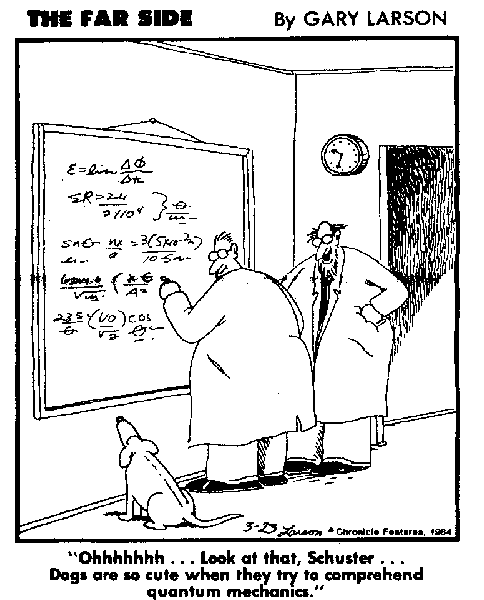 The simulation hypothesis is perhaps a bit more interesting than how to add clusters of neural network nodes to do a simple reference resolution task, but it is also less testable. This is the nature of big questions since they would otherwise have been resolved by now. Nevertheless, some theory and experimental analysis has been undertaken for the question of whether or not we are living in a simulation, all based on an assumption that the strangeness of quantum and relativistic realities might be a result of limited computing power in the grand simulator machine. For instance, in a virtual reality game, only the walls that you, as a player, can see need to be calculated and rendered. The other walls that are out of sight exist only as a virtual map in the computer’s memory or persisted to longer-term storage. Likewise, the behavior of virtual microscopic phenomena need not be calculated insofar as the macroscopic results can be rendered, like the fire patterns in a virtual torch.