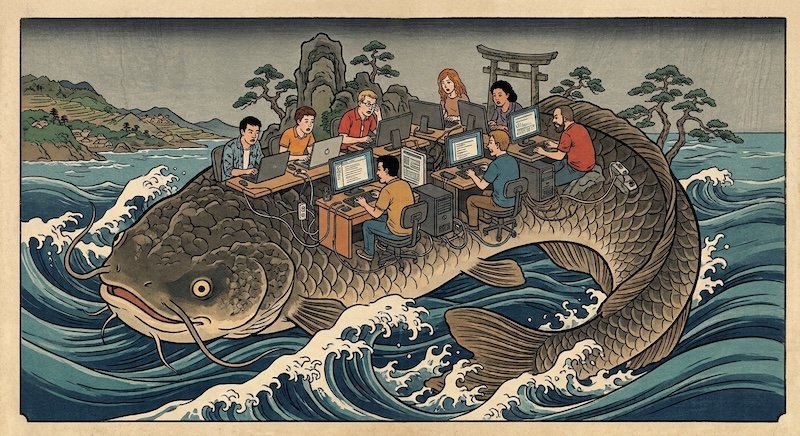
On a number of occasions, I have proposed the use of prediction markets for policy refinement and decisions, an idea that has long been studied in corporate and academic arenas. Unexpectedly, the startup set was busy turning the concept into just another gambling experience, rewarding influencers and insiders while fleecing the masses. But I want to revisit the idea in light of the mid-term “blue tsunami,” post “meteor-strike extinction event.” There are new opportunities to repair the damage of Trumpism as well as create policy structures to reestablish norms for government interaction.
First, populism and protectionism don’t solve problems, they exacerbate them and steamroll common sense. We see this in the broad use of tariffs and the inverted logic and emotional appeals that accompanied their application. Instead, this is a topic best left to technocrats finding solutions to political and economic problems, which means using tariffs in a narrow fashion to specifically address asymmetries in trade between nations. We are not going to correct Chinese industrial overcapacity by taxing Americans, for instance, but we can focus on those areas of trade imbalance that impact national security in a targeted fashion. Using tariffs to enhance industries like the automotive sector is fine on the surface, but it can also raise domestic product prices by eliminating or weakening competition. The technocrats can model all this and should offer politicians a collection of policy responses with well-articulated risk-reward matrixes.
There are a clutch of political meta-theories that are conjoined as epistemic democracy and that focus on how knowledge and information flow into democratic decision making. A fundamental question is how to choose who should do the governing in terms of solving problems of thriving? If we consider thriving landscapes as mathematical multivariate functions and we set a group of explorers out onto them with the goal of finding the best mix of variables (abstractly the maxima or minima), then it is perhaps obvious that a diverse group of explorers starting at diverse points on the surface has a higher chance of success than a more uniform group starting from similar areas. The math of this is very similar to simulated evolution or annealing models. This idea, in turn, leads to suggestions for new models of more highly participatory democracy, a la Hélène Landemore. In Landemore’s model, sortition (selecting democratic decision-making participants by lot) is used to guarantee diversity in the deliberative body. There are some interesting technical critiques of this system that revolve around whether it is possible to discern the best solutions to complex problems (the “oracle” problem), but this can be overcome by simply noting that non-diverse subsets of decision makers overlay one another and provide diminishing returns regardless of how discernible the best outcomes might be.
Taking a step back, though, we can also lean into some of the other, related ideas to both increase diversity in problem solving and to help refine solutions. One of the risks of diversity in idea generation is that too many of them are non-starters. Technocratic filtering and refinement is needed. This is where a national policy prediction market can potentially add value. Any citizen can participate, propose solutions and vote on them. No need for sortition, just jump in. Subject matter experts then refine them with knowledge trails concerning the environmental, economic, social, health, security, foreign relations, and other consequences. Voters can withdraw support or modify it, and can even do ranked-choice votes on the available proposals.
This is all boring and bloodless, unlike authoritarian populism with evil enemies and conspiratorial cabals. It’s exactly what is needed to actually make progress, sane and incremental, on complex problems in our connected world.
No AI was used in writing. Gemini helped me generate the image based on Japanese Namazu prints connecting catfish to earthquakes and tsunamis.