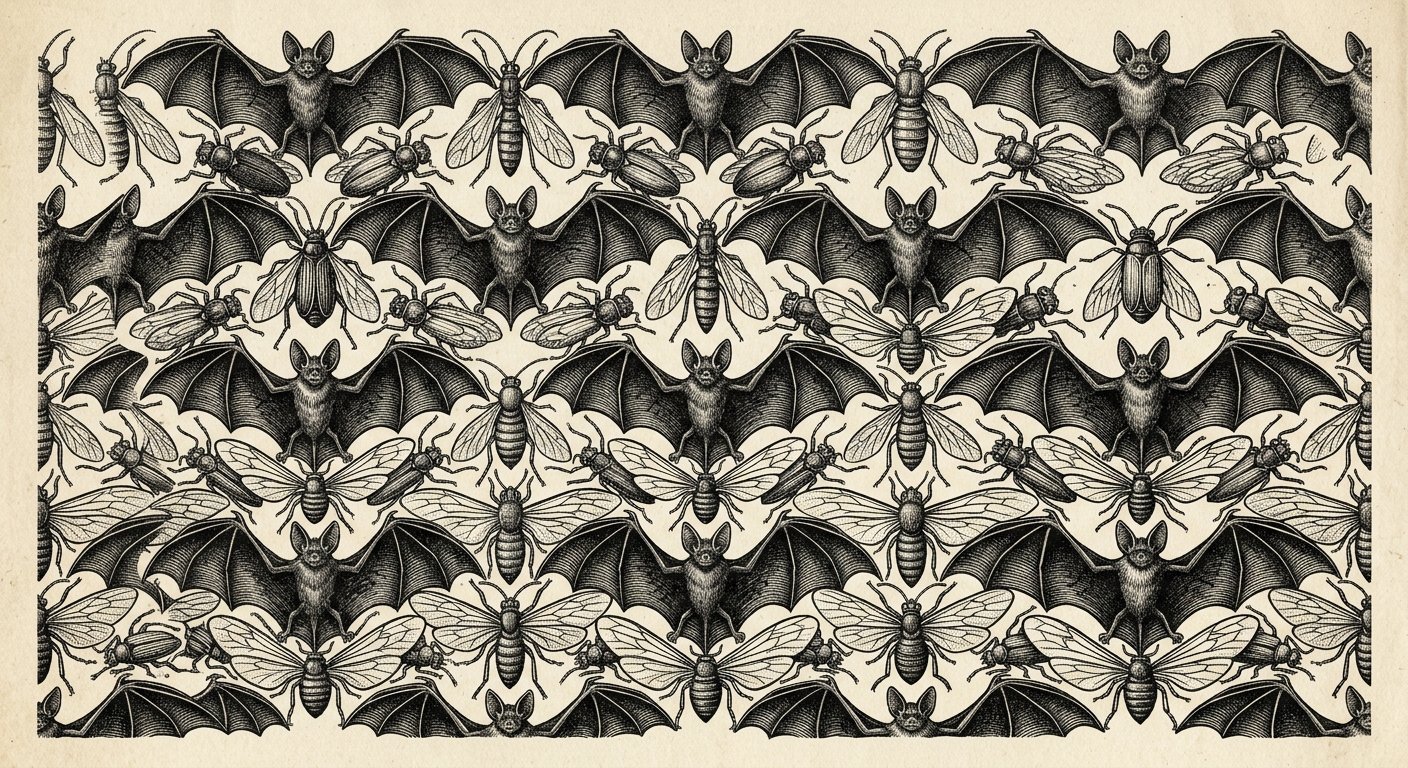
I invoked Nagel’s ”What Is It Like to Be Bat?” in a brief blurb I recently wrote about a children’s book. Nagel’s essay came to mind because I was rereading PMS Hacker’s “IS THERE ANYTHING IT IS LIKE TO BE A BAT?,” which is shrilly capitalized in this online version. Hacker, as always, is ready with Wittgenstein for some final comments after having worked through the weird conceptual structures that attend to ideas like “what is it like to be something.”
In preparation, Hacker works his way through the transitive and intransitive concepts of consciousness (being conscious of something versus simply being awake and aware), then through how we talk about and conceive of phenomenal relationships between experiences and descriptions of the objects of those experiences. He ultimately dismisses all this “qualia” discussion in philosophy of mind:
None of this is mysterious, surprising or baffling. Nor is it the key to unlocking the mysteries of consciousness. For there are no mysteries — only empirical ignorance and conceptual mystification.
There is an interesting fissure in Hacker’s argument, I think, and it is exemplified by exactly the line of reasoning that he borrows from Wittgenstein and that dovetails with W’s notion of private language. The concern is with the objects of experience when using abstract references like “this,” “that,” and “thus”:
One would like to say ‘I see red thus,’ ‘I hear the note that you strike thus,’ ‘I feel sorrow thus,’ or even ‘This is what one feels like when one is sad, this when one is glad,’ etc. One would like to people a world, analogous to the physical one, with these thuses and thises. But this makes sense only where there is a picture of what is experienced, to which one can point as one makes these statements.
In other words, there is no “like this” to our experience unless we can point at something, some picture, of what it is that we are experiencing.
And the gap?
Perhaps Nagel and Searle and Chalmers and Dennett and others were flawed in the way they explained qualia or the surely uniquely batty nature of battiness, but there are certainly ways of creating mental pictures of things. The way is through analogies, metaphors, allusions, similes, and narrative structures. The experience of being a bat surely has some kind of three-dimensional representation of the nearby objects as revealed by echolocation. The bat must have some kind of special detection facility for the motion of insects or good fruit sources.
We can, thus, point to this conceptual structure of informed imagination as a kind of picture. Just like we can substitute “like an apple” for “thus” in “I see red thus,” so can we substitute “like a three-dimensional video-game-like terrain map” for the target of “the bat sees the world thus” This preserves the ability to think about the internal character of subjective experience without giving into “conceptual mystification.” Indeed, the best narratives to point at are exactly the detailed ones created by natural scientists trying their best to convey the discoveries at the heart of their work, exactly the kinds of possible worlds that survive the sieve of reasonableness.
No AI in writing. Image by Google Gemini. Written on a plane flying to a funeral. RIP, A.M.
Edits!