I am trying to imagine the difficulties that translator J.B. Sykes encountered when working on Erhard Scheibe’s The Logical Analysis of Quantum Mechanics from 1973. The translation process extended through to the Danish of Bohr himself, the primary subject of Scheibe’s book (likely in German). The complexities of describing the evolving theory and the strange logic that envelops quantum physics were clearly apparent in Scheibe’s project. About Bohr’s writing, he reports:
Bohr’s mode of expression and manner of argument are individualistic sometimes to the point of being repellent…”
and:
Thus, although Bohr himself testifies to his wish to present his view at least partly as a complex of causes or a hierarchy of concepts and statements having various degrees of priority, there is still good reason to question whether he succeeded in doing so intelligibly.”
But I am not here to further pile on Bohr. New concepts like complementarity were extremely strange. Instead, I want to emphasize the important role that philosophy can have in the analysis of arguments and conceptual structures. Quantum mechanics remains a unique example of something that is both the basis for the reality we observe and yet completely alien to the everyday reality we encounter at human scale. It needs contextualization in order to make progress. From “spooky” action-at-a-distance to Everett’s many-worlds interpretation, quantum logic is a thus far intractably weird thing. As a philosophical topic for analysis, it escapes the complaint of being a purely mental or a priori construct of pure thought, the kinds of omphaloskepsis that extend back to Classical Greece.
I was considering all this in the context of much discussion of value hierarchies in fields like philosophy that have been circulating on Substack. For instance, are concepts like effective altruism abstractly divorced from real issues of human development due to their inherent mathematization of cost-benefit analyses? Is philosophy of religion a total waste of time and academic energy? Is religious study itself of little value, from theology to textual criticism? Maybe all the humanities should be reconsidered and ordered according to their tangible value to human flourishing? Is the only proper role for a field like philosophy as a handmaiden of science, helping with the disentanglement of complex concepts like genes or Bohr’s complementarity?
I have my doubts. I think general skepticism and epistemic humility points to the value of a rich landscape of intellectual pursuits. The model of variation and selective retention remains an algorithm of notorious success for biology, creativity, and even economics. Freedom is wasteful and all of the humanities are constantly in fear of their displacement, defunding, and extinction, but I still read poetry, prose, dry analytic philosophy, and am amazed by conceptual art that helps us flourish not by material gain but by a revelation of its cultural worth disconnected from material well-being. Philosophy of religion may give us some weird ideas like religious belief as being “properly basic,” thus ending rational critique, but I think not knowing how Hindu and Buddhist worldviews contrast and align with Middle Eastern traditions would impoverish the world. In the phylogenetic tree of ideas there are withering lineages and new shoots as well.
About complementarity:
Bohr evidently regarded this failure [of classical physics] as a direct consequence of the impossibility of complete surveillance of the interaction in measurement.
We cannot know certain things or fully optimize the future. We are blocked until we discover it. It may, in fact, not be predictable at all. In our landscape of cultural intelligence, we can only cultivate the many flowers according to, at a minimum, their ability to attract interest, attention, some (occasionally paying) grad students, and tangible little motes of novelty. It will be messy and occasionally repellent.
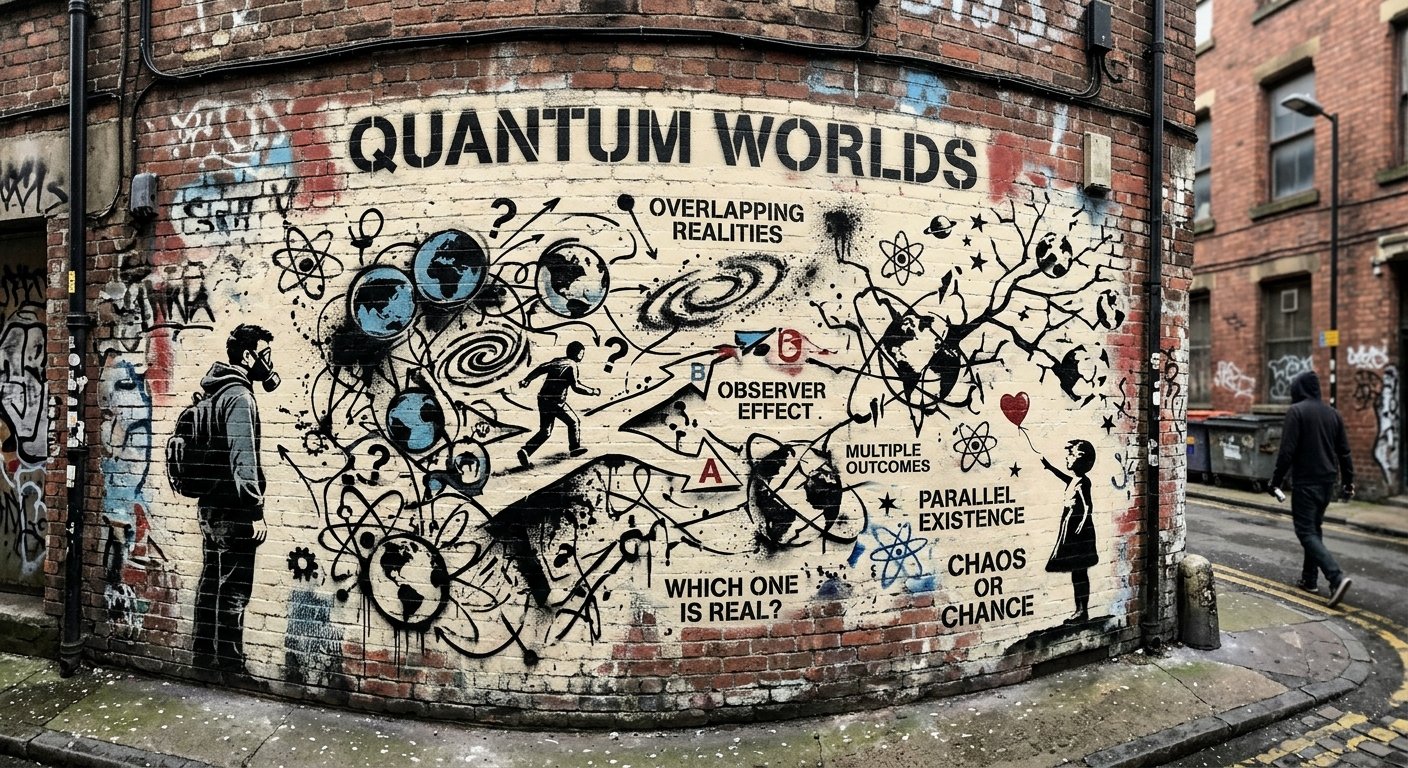
No AI used for writing. Image from Gemini: “create an image of quantum worlds in the style of Banksy.”