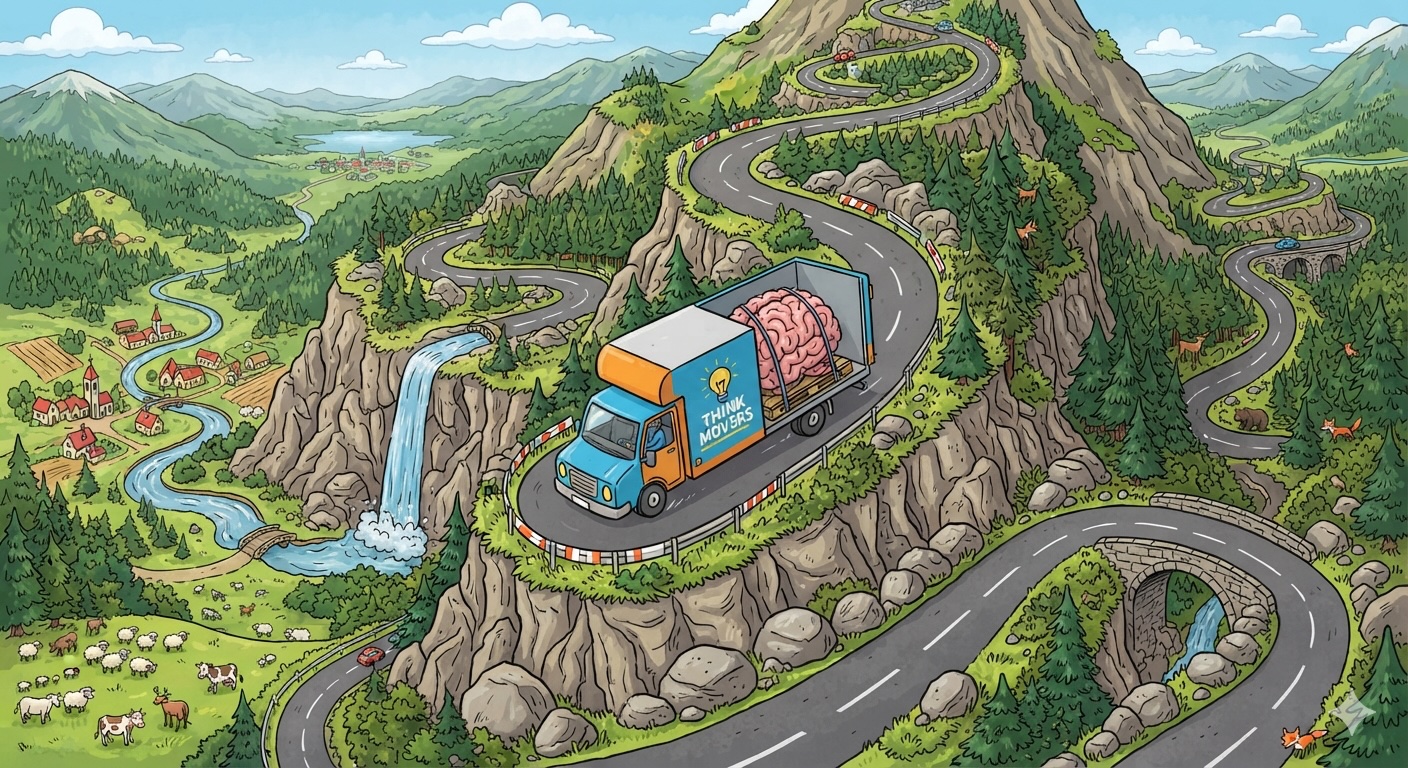
I’ve had a longer-than-usual hiatus from posting due to adding a new living arrangement to our small collection. Acquiring and moving furniture, appliances, toiletries, bedding, audio equipment, and cleaning supplies between spaces has an almost unlimited ability to distract. And when a quiet finally settles in, there remains a restlessness about optimizing experiences and priorities that takes time to psychically draw down. It’s the clattering opposite of focusmaxxing. On the positive, new places constantly reset and tune expectations about what is important and what matters little in a life, with people, ideas, and new experiences always rising above the glimmer of these damn possessions.
This rich inner life, this sense of a self that powers the great religions and mystical traditions of the world, this atman and soul, these ideas of impermanence, justice, and wonder—can they all be a product of a versatile connective matrix that computes these optimizing decisions while simultaneously creating a vital subjective sense of identity? There is a theory called unlimited associational learning (UAL) that posits exactly that. Our adaptation to the world is one of temporal superiority. A plan and a reaction for a conscience entity is a function for pulling time apart and predicting the future, from the cause-effect of seasonal migrations of herd animals to estimating the supportive and defensive capabilities of mates.
The essential hinge is that this consciousness, this sense of being someone, must on average be more effective than the other trajectories through the phylogenetic, epigenetic, and ontogenetic state spaces. And that’s even with all the flaws like misperceptions, biases, neurological injuries, and schizophrenia. Proving this with any sort of mathematical precision has an almost impossible bar to meet since it would require that a model first is shown to be conscious with the set of UAL-sufficient hallmarks, like global accessibility, integration over time, agency and embodiment, and so on. It’s not quite enough to model them as, say, linear or nonlinear equations that relate environmental variables to internal variables or states. That’s just functionalism again and the scandalous “hard problem” pops in where a philosopher can simply deny that matter and their relationships are ever capable of intentionality or agency in exactly the way they want to define those terms. Material, computable functions are not capable of subjectivity because the subjective is a phlogiston that coexists with but is not the same material thing. Ditto for the atman-ists and soul savers.
The “unlimited” in UAL was chosen to parallel unlimited heredity, a concept that describes the combinatoric versatility in genetics as an adaptive strategy. Unlimited learning supports complex modeling within lifetimes, within moments and days, while unlimited heredity solves adaptation problems over generations. There is even some crossover, some cross-fertilization (because most thought is metaphor expansion and reapplication) in notions like evolutionary epistemology, where combinations of ideas evolve through sieves of selection and refinement. My Berggruen essay pulls in a similar pattern as way of deconstructing the “hard problem of free will” in a world of determinism by building a robot that uses random mixing and selective retention as a core feature of its intelligence.
But even if we grant all of UAL’s hallmarks of consciousness and start building models that invoke them, at what point can we ever be certain that consciousness is in there? UAL postulates that for vertebrates and a few other orders and species there is good scientific support for many of the hallmarks. Thus there must be a continuum but we are blocked from investigating the subjective component because of language barriers, though some crows have loudly suggested otherwise to me. The functional structure of a model is much the same, but I think there may be a way to take a closer look. For example, if we can compare models that have and don’t have strong correlates of certain hallmarks, we might gain some insight into not just their sufficiency but also their necessity to the “Difficult Thing” (in a nod to both Chalmers and Dennett) of consciousness. Take “selective attention.” Against a complex environment, do varying levels of selective attention enhance model success? Having complete attention to every perceptual and historical detail is possible in theory, and having exquisite memory of many things is even possible in practice, yet selective attention as a hallmark and psychological fact limits what we can track and recall. There is, however, a line of reasoning in algorithmic inference that optimal inference is mostly about ignoring or minimizing the noisy parts of the signal over multiple exposures during optimization training. If the selective attention hallmark was shown to be consistently better in the presence of complex, noisy environments then we would be able to move the needle from sufficiency into necessity. Our consciousnesses are limited in the attentional hallmark in support of unlimited learning, which is the ultimate causal valence.
Oh my, this is a longish apologia for my distracted moving-mind, now that I look back at the above. I had problems to solve, planning to get done, molecules to move, and modeling about it all. But my limits, my focus, was culling out the distractions as a hallmark of what sure feels like consciousness (on a good day).
NOTE: Image above is AI (Google Gemini). No AI is used in writing.
Edits!
More edits…Atman!