Unpacking the proof copy of Against Superheroes:… Read the rest
Against Superheroes and Novel Next
Editing is complete, cover designs are converging with new trade hardcover dustjacket form factors arriving, and all is looking swimmingly for a release in the immediate future. In the meantime, my next novel, racing to the front of the line ahead of the much-delayed Pornotopia and the impossibly ambitious Vin Diesel Versus the Vampires (An embedded board game? A film about the failure of the described unmade film? Really?), is ¡Reconquista!, a comedy incited by contemporary politics and my return to the border region.
It could only be a comedy, I decided. Anything less or more would be too heartbreaking.
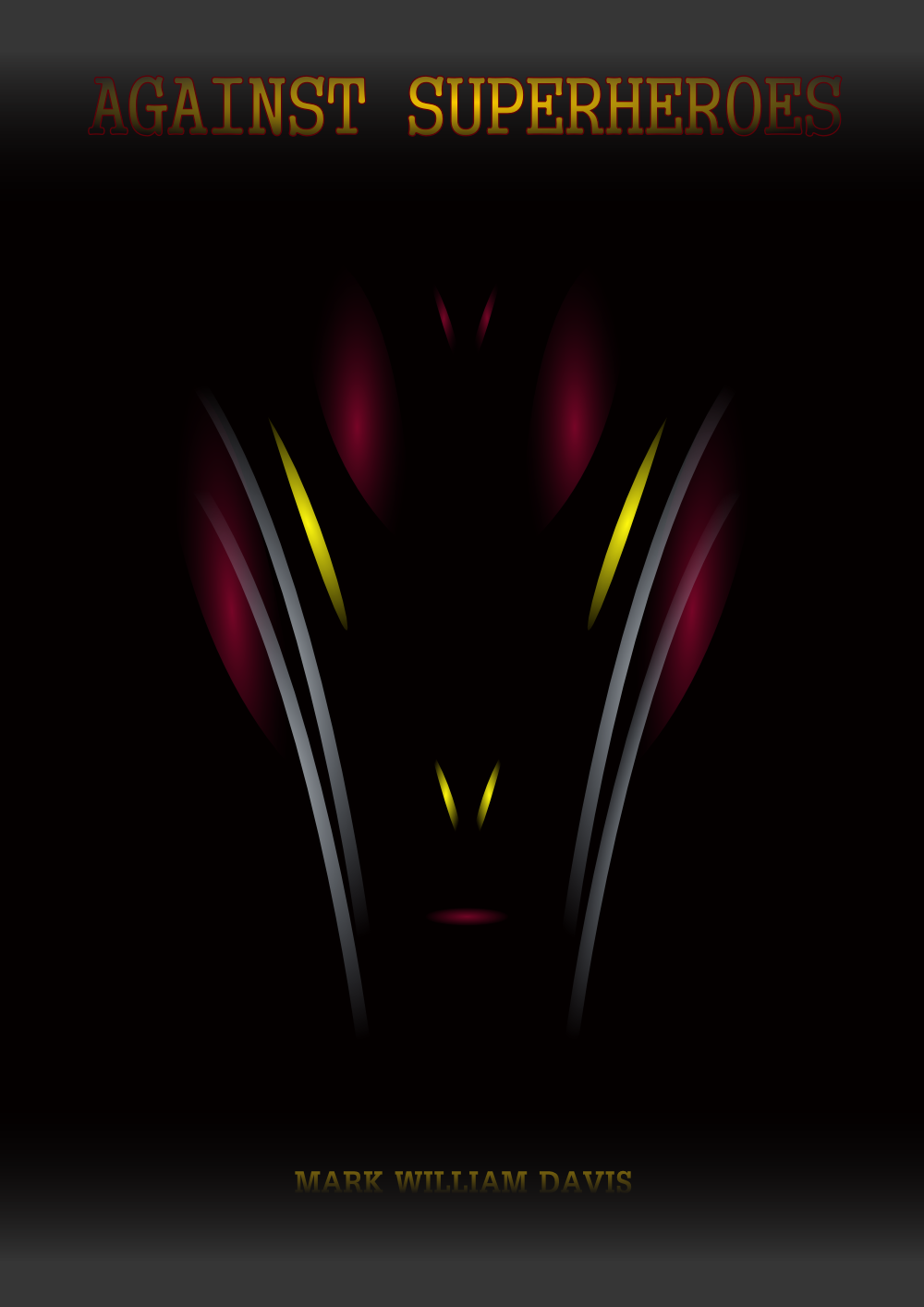
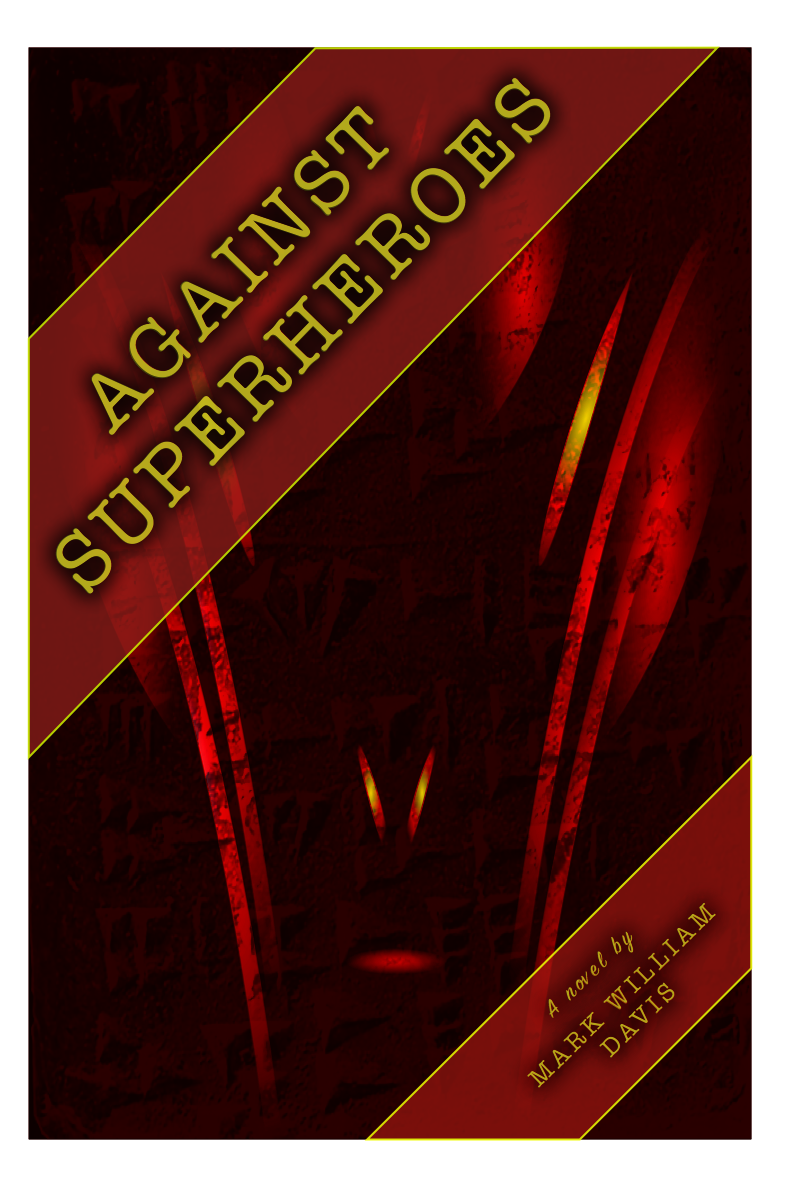
Here are the new cover contenders for Against Superheroes, both of which introduce Ugaritic glyphs to provide a background shade to the Baalic figure who is, of course, against the very notion of superheroes. v7 looks like the leader in this race…
Boredom and Being a Decider
Seth Lloyd and I have rarely converged (read: absolutely never) on a realization, but his remarkable 2013 paper on free will and halting problems does, in fact, converge on a paper I wrote around 1986 for an undergraduate Philosophy of Language course. I was, at the time, very taken by Gödel, Escher, Bach: An Eternal Golden Braid, Douglas Hofstadter’s poetic excursion around the topic of recursion, vertical structure in ricercars, and various other topics that stormed about in his book. For me, when combined with other musings on halting problems, it led to a conclusion that the halting problem could be probabilistically solved by an observer who decides when the recursion is too repetitive or too deep. Thus, it prescribes an overlay algorithm that guesses about the odds of another algorithm when subjected to a time or resource constraint. Thus we have a boredom algorithm.
I thought this was rather brilliant at the time and I ended up having a one-on-one with my prof who scoffed at GEB as a “serious” philosophical work. I had thought it was all psychedelically transcendent and had no deep understanding of more serious philosophical work beyond the papers by Kripke, Quine, and Davidson that we had been tasked to read. So I plead undergraduateness. Nevertheless, he had invited me to a one-on-one and we clashed over the concept of teleology and directedness in evolutionary theory. How we got to that from the original decision trees of halting or non-halting algorithms I don’t recall.
But now we have an argument that essentially recapitulates that original form, though with the help of the Hartmanis-Stearns theorem to support it. Whatever the algorithm that runs in our heads, it needs to simulate possible outcomes and try to determine what the best course of action might be (or the worst course, or just some preference).… Read the rest
Traitorous Reason, Facts, and Analysis
Obama’s post-election press conference was notable for its continued demonstration of adult discourse and values. Especially notable:
This office is bigger than any one person and that’s why ensuring a smooth transition is so important. It’s not something that the constitution explicitly requires but it is one of those norms that are vital to a functioning democracy, similar to norms of civility and tolerance and a commitment to reason and facts and analysis.
But ideology in American politics (and elsewhere) has the traitorous habit of undermining every one of those norms. It always begins with undermining the facts in pursuit of manipulation. Just before the election, the wizardly Aron Ra took to YouTube to review VP-elect Mike Pence’s bizarre grandstanding in Congress in 2002:
And just today, Trump lashed out at the cast of Hamilton for lecturing Mike Pence on his anti-LGBTQ stands, also related to ideology and belief, at the end of a show.
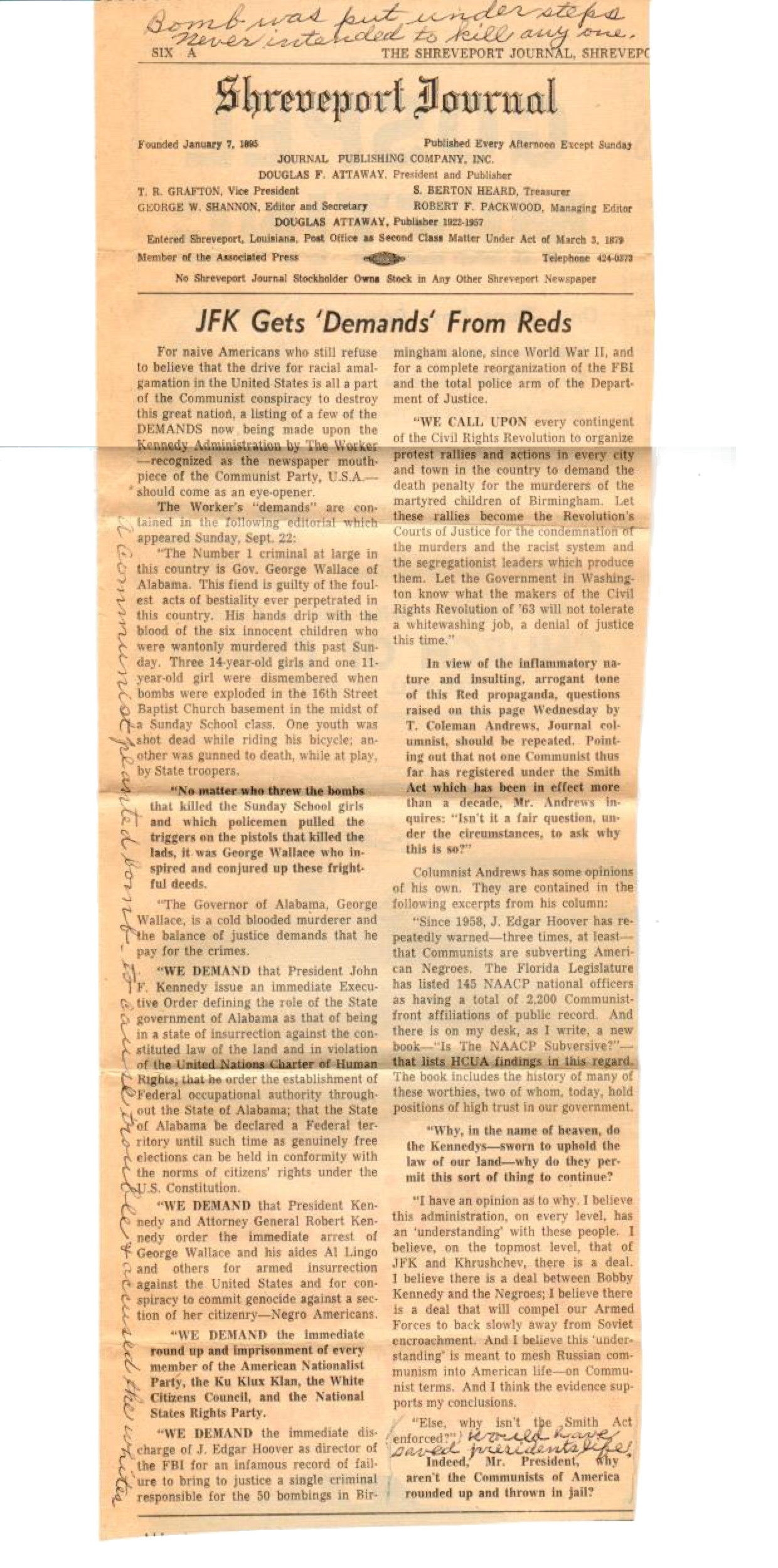
Astonishing as this seems, we live in an imperfect world being drawn very slowly away from tribal and xenophobic tendencies, and in fits and starts. My wife received a copy of letter from now-deceased family that contained an editorial from the Shreveport Journal in the 1960s that (with its embedded The Worker editorial review) simultaneously attacked segregationist violence, the rhetoric of Alabama governor George Wallace, claimed that communists were influencing John F. Kennedy and the civil rights movement, demanded the jailing of communists, and suggested the federal government should take over Alabama:
The accompanying letter was also concerned over the fate of children raised as Unitarians, amazingly enough, and how they could possibly be moral people. It then concluded with a recommendation to vote for Goldwater.… Read the rest
A Big Data Jeremiad and the Moral Health of America
The average of polls were wrong. The past-performance-weighted, hyper-parameterized, stratified-sampled, Monte Carlo-ized collaborative predictions fell as critically short in the general election as they had in the Republican primary. There will be much soul searching to establish why that might have been; from ground game engagement to voter turnout, from pollster bias to sampling defects, the hit list will continue to grow.
Things were less predictable than it seemed. During the 2008 and 2012 elections, the losing party proxies held that the polls were inherently flawed, though they were ultimately predictive. Now, in 2016, they were inherently flawed and not at all predictive.
But what the polls showed was instructive even if their numbers were not quite right. Specifically, there was a remarkable turn-out for Trump among white, less-educated voters who long for radical change to their economic lives. The Democratic candidate was less clearly engaging.
Another difference emerged, however. Despite efforts to paint Hillary Clinton as corrupt or a liar, objective fact checkers concluded that she was, in fact, one of the most honest candidates in recent history, and that Donald Trump was one of the worst, only approximated by Michelle Bachman in utter mendacity. We can couple that with his race-bating, misogyny, hostility, divorces, anti-immigrant scapegoating, and other childish antics. Yet these moral failures did not prevent his supporters from voting for him in numbers.
But his moral failures may be precisely why his supporters found him appealing. Evangelicals decided for him because Clinton was a threat to overturning Roe v. Wade, while he was an unknown who said a few contradictory things in opposition. His other moral issues were less important—even forgivable. In reality, though, this particular divide is an exemplar for a broader division in the moral fabric of America.… Read the rest
Against Superheroes, Chapter 22
As I watched over the Nepalese countryside populated by small hilltop compounds, the irregular terraces of rice paddies reflected the clouds in their muddy mirrors. I had taken on a certain quality of stasis here, frozen above a jungle mountain in an envelope of mist.
I took to trying to mine my memories, to unravel these chains of semantic and temporal associations that reached back through the gray wall of my origins. It was maddeningly difficult, shifting through trapezoids of connections shot through with scientific and technical associations, and with the addition of the perspectives of the people who I had possessed, but I achieved some clarity with diligence and strain. When my mind wandered out to those rice paddies and the tiny shifting figures tending to them, or to the small vans that struggled along the high, sloppy roads, or when the focus moved to the dancing energies of the sky and moisture, I learned to return to this rummaging by counting slowly by threes or by prime numbers, up and down, the necessity of the mental acrobatics pushing the imagery back into a halo around the mathematical gears until they were finally erased, and I returned to the signals of my past.
There I was again, in graduate school, the poetic inflections of the Orphic hymns impressing me until I began writing my own inspired variations, like a composer copying and reordering works by Baroque masters. This theme of divinity, from the Vedas through to the Native American myths, from the Slavic translations to the Babylonian Baals, was always the encompassing and central element of the written and oral traditions.
And all these texts reflected a time when the human mind was only connected to one town, almost always to agriculture, subject to the whims of the seasons and the terror of sickness, and then often forced into violence by the more powerful or by passions that arose without control.… Read the rest
Desire and Other Matters
“What matters?” is a surprisingly interesting question. I think about it constantly since it weighs-in whenever plotting future choices, though often I seem to be more autopilot than consequentialist in these conceptions. It is an essential first consideration when trying to value one option versus another. I can narrow the question a bit to “what ideas matter?” This immediately externalizes the broad reality of actions that meaningfully improve lives, like helping others, but still leaves a solid core of concepts that are valued more abstractly. Does the traditional Western liberal tradition really matter? Do social theories? Are less intellectually-embellished virtues like consistency and trust more relevant and applicable than notions like, well, consequentialism?
Maybe it amounts to how to value certain intellectual systems against others?
Some are obviously more true than others. So “dowsing belief systems” are less effective in a certain sense than “planetary science belief systems.” Yet there are a broader range of issues at work.
But there are some areas of the liberal arts that have a vexing relationship with the modern mind. Take linguistics. The field ranges from catalogers of disappearing languages to theorists concerned with how to structure syntactic trees. Among the latter are the linguists who have followed Noam Chomsky’s paradigm that explains language using a hierarchy of formal syntactic systems, all of which feature recursion as a central feature. What is interesting is that there have been very few impacts of this theory. It is very simple at its surface: languages are all alike and involve phrasal groups that embed in deep hierarchies. The specific ways in which the phrases and their relative embeddings take place may differ among languages, but they are alike in this abstract way.… Read the rest
Theories of Leisure, Past and Future
I am at leisure. Specifically—and many may not regard this as leisure—I just ran 17.71 miles in Yosemite Valley. I dropped the car along the road near the 41 junction and then just started running. I went south for a while, then circled back to Bridalveil Falls (lightly flowing), then up to the Glacier Point loop, then back down to El Capitan, then up to Yosemite Falls (not flowing). Lunch was at the Village and then I tracked down the car again.
Now, then, I am at leisure. The barman has set me up with a martini. I have a Fresno Fig flatbread on the way: goat cheese, bacon, arugula, and the critical figs. I am showered all the way down to between my toes. The late afternoon light is filtering through a mild haze onto the muddy belly of the lake. There must be bass out there somewhere. Let the bass live. Let them be at leisure.
A must-read on this topic is Derek Thompson’s Atlantic article, The Free-Time Paradox in America. I don’t agree with the thesis, though. It’s not really a paradox. It’s just an unknown. You should read Derek’s original, but I will comment briefly on some of his points. He argues that John Maynard Keynes forecast a reduction in work requirements by the 21st Century. Mechanization would take the drudgery out of most things and we would get to 15 hour work weeks with the management of our leisure time an increasing burden on us.
The present didn’t work out that way.
Instead, educated high-earners work ever harder. The only leisure class is the non-college-educated male youth who don’t work much these days but instead play video games (75% of their spare time) and are happier than when more of them worked.… Read the rest
Subtly Motivating Reasoning
Continuing on with the general theme of motivated reasoning, there are some rather interesting results reported in New Republic, here. Specifically, Ian Anson from University of Maryland, Baltimore County, found that political partisans reinforced their perspectives on the state of the U.S. economy more strongly when they were given “just the facts” rather than a strong partisan statement combined with the facts. Even when the partisan statements aligned with their own partisan perspectives, the effect held.
The author concludes that people, in constructing their views of the causal drivers of the economy, believe that they are unbiased in their understanding of the underlying mechanisms. The barefaced partisan statements interrupt that construction process, perhaps, or at least distract from it. Dr. Anson points out that subtly manufacturing consent therefore makes for better partisan fellow travelers.
There are a number of theories concerning how meanings must get incorporated into our semantic systems, and whether the idea of meaning itself is as good or worse than simply discussing reference. More, we can rate or gauge the uncertainty we must have concerning complex systems. They seem to form a hierarchy, with actors in our daily lives and the motivations of those we have long histories with in the mostly-predictable camp. Next we may have good knowledge about a field or area of interest that we have been trained in. When this framework has a scientific basis, we also rate our knowledge as largely reliable, but we also know the limits of that knowledge. It is in predictive futures and large-scale policy that we become subject to the difficulty of integrating complex signals into a cohesive framework. The partisans supply factoids and surround them with causal reasoning.… Read the rest
Startup Next
I’m thrilled to announce my new startup, Like Human. The company is focused on making significant new advances to the state of the art in cognitive computing and artificial intelligence. We will remain a bit stealthy for another six months or so and then will open up shop for early adopters.
I’m also pleased to share with you Like Human’s logo that goes by the name Logo McLogoface, or LM for short. LM combines imagery from nuclear warning signs, Robby the Robot from Forbidden Planet, and Leonardo da Vinci’s Vitruvian Man. I think you will agree about Mr. McLogoface’s agreeability:
You can follow developments at @likehumancom on Twitter, and I will make a few announcements here as well.… Read the rest