The Art of War

I was moved today by images and video of Ukrainian citizens taking up arms against Russian aggression. I contrasted those images with a drier, intellectualized stream of essays and opinion pieces from WaPo, NY Times, CNN, BBC, Atlantic, and others. I now know the history and conflicted consequences of NATO expansion, as well as how it was blocked in Georgia and now Ukraine by corrupted roadmaps for implementation. I expanded my understanding of Taiwan and colonial states’ self-determination after World War II. I read up on how Javelin missile systems work. I dipped into Honoré de Balzac’s “The Girl with the Golden Eyes” because, well, it was waiting for me. I bought Robert Altman’s M*A*S*H and watched half of it because Sally Kellerman died recently. It was all war, security, brutality, hopelessness, idealizations and global order, plus a layer cake of 19th-century Parisian capitalist critique wrapped up in interminable verbiage to resemble a short story (I stumbled along in French, truly, as well. It didn’t make it better.)

What was left to do?

Music, clearly. There must be perfect pieces and composers for this moment. First, we start with Ukraine itself, and Lysenko. Qobuz gives us Solmia Soroka and Arthur Greene’s Mykola Lysenko: Complete Music for Violin and Piano. Lysenko was an ethnomusicologist who specialized in Ukrainian folk music and represents the Romantic trends of his time, doing for Ukrainian fiddling what Brahms did for Hungary (cultural appropriation much?) or Dvořák and Smetana for Czech sensibilities.

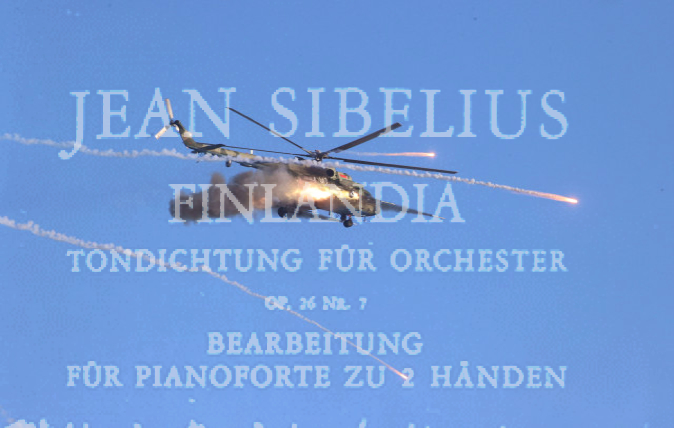
But what of war, invasion, and resistance? We can start with Sibelius’s Finlandia because a day with Sibelius is always an epic adventure, and winter ups the ante. Finlandia served as an artistic attack on Russian censorship and russification, performed using alternative titles and lyrics.… Read the rest

We Are Weak Chaos

Recent work in deep learning networks has been largely driven by the capacity of modern computing systems to compute gradient descent over very large networks. We use gaming cards with GPUs that are great for parallel processing to perform the matrix multiplications and summations that are the primitive operations central to artificial neural network formalisms. Conceptually, another primary advance is the pre-training of networks as autocorrelators that helps with smoothing out later “fine tuning” training programs over other data. There are some additional contributions that are notable in impact and that reintroduce the rather old idea of recurrent neural networks, networks with outputs attached back to inputs that create resonant kinds of running states within the network. The original motivation of such architectures was to emulate the vast interconnectivity of real neural systems and to capture a more temporal appreciation of data where past states affect ongoing processing, rather than a pure feed-through architecture. Neural networks are already nonlinear systems, so adding recurrence just ups the complexity of trying to figure out how to train them. Treating them as black boxes and using evolutionary algorithms was fashionable for me in the 90s, though the computing capabilities just weren’t up for anything other than small systems, as I found out when chastised for overusing a Cray at Los Alamos.

But does any of this have anything to do with real brain systems? Perhaps. Here’s Toker, et. al. “Consciousness is supported by near-critical slow cortical electrodynamics,” in Proceedings of the National Academy of Sciences (with the unenviable acronym PNAS). The researchers and clinicians studied the electrical activity of macaque and human brains in a wide variety of states: epileptics undergoing seizures, macaque monkeys sleeping, people on LSD, those under the effects of anesthesia, and people with disorders of consciousness.… Read the rest

Leon, Humanism, and Modesto

Modesto, California has a motto that sits proudly on an arched sign as one enters the city from the teaming congestion of Highway 101 that rumbles with diesel trucks through the agriculture core of the state: “Water Wealth Contentment Health.” It is a throwback to The Golden State’s climate and the hope for a better life that led settlers to Modesto (Spanish for “modest”). The goal back then was to build and create, to achieve something where nothing previously existed. There are plenty of caveats we can lard on concerning the fates of indigenous peoples and consequences of the water management system that made it all possible, but the goal of bettering oneself and growing wealthy and content was a driving force across America—an obvious extension of “The Pursuit of Happiness” encoded in the US Constitution.

So it might seem strange that billionaire Leon Cooperman appears in The Washington Post confused about whether or not his success is some kind of moral failure. He came from modest roots, worked his way through college and graduate school, and then worked to make money on Wall Street. Now, with family grown, he still works at making money every day. He lives in an expensive home, but less than he could afford, drives a modest car, and shops deals at Costco. He also gives away prodigious amounts of money to educational and social charities, and he has pledged to give away most of it before death.

Plaudits on success and a long life. He is modesto, mostly, though some of his personal sentiment (at least as reported in the WaPo article) could be a bit more refined. Of a showy Bentley in his neighborhood: “…I could buy and sell that guy 100 times.”… Read the rest

Triangulation Machinery, Poetry, and Politics

I was reading Muriel Rukeyser‘s poetry and marveling at some of the lucid yet novel constructions she employs. I was trying to avoid the grueling work of comparing and contrasting Biden’s speech on the anniversary of January 6th, 2021 with the responses from various Republican defenders of Trump. Both pulled into focus the effect of semantic and pragmatic framing as part of the poetic and political processes, respectively. Sorry, Muriel, I just compared your work to the slow boil of democracy.

Reaching in interlaced gods, animals, and men.
There is no background. The figures hold their peace
In a web of movement. There is no frustration,
Every gesture is taken, everything yields connections.

There is a theory about how language works that I’ve discussed here before. In this theory, from Donald Davidson primarily, the meaning of words and phrases are tied directly to a shared interrogation of what each person is trying to convey. Imagine a child observing a dog and a parent says “dog” and is fairly consistent with that usage across several different breeds that are presented to the child. The child may overuse the word, calling a cat a dog at some point, at which point the parent corrects the child with “cat” and the child proceeds along through this interrogatory process, triangulating in on the meaning of dog versus cat. Triangulation is Davidson’s term, reflecting three parties: two people discussing a thing or idea. In the case of human children, we also know that there are some innate preferences the child will apply during the triangulation process, like preferring “whole object” semantics to atomized ones, and assuming different words mean different things even when applied to the same object: so “canine” and “dog” must refer to the same object in slightly different ways since they are differing words, and indeed they do: dog IS-A canine but not vice-versa.… Read the rest

The Evolution of Theological Commitments

My wife studies pagan mythology, among other pursuits, and she recently undertook some of the Norse background in a far deeper way than my own shallow assemblage of role-playing references, fictional mentions, and Marvel movies. She happened to mention the other day that Christian chroniclers like Snorri Sturluson likely adapted the pre-existing mythos in order to achieve a syncretic outcome. Loki was demonized to create a dualist conflict. Ragnarök may have been created out of whole, fresh cloth in order to extinguish the pantheon and make way for the new religion.

John McKinnell studies the narratives that the Norse proselytizers used to achieve the conversion of the pagans, as well as the influence and outcomes of those people. There is a theological problem for them in terms of explaining the existence of the pagan deities that is largely solved by simply describing them as devils or as personifications of natural phenomena. They transmogrify from real to a netherworld nestled somewhere between mythic, poetic, and literal evils.

I had nearly simultaneously joined the Bart Ehrman Blog because of a post that got repeated in one of his podcasts I happened to catch. The post is from a guest contributor who uses scholarship from Mark Smith and others to detail a model of the transformation into monotheism from earlier Canaanite pantheons. In this model, during the Second Temple Period, the success of the god Marduk’s people over Yahweh’s tribes requires a theological reinterpretation in order to explain Yahweh’s defeat. How can YHWH be the greatest god under such circumstances? The answer is easy, though. Marduk is just a puppet of YHWH and the literal military victory is a divine punishment. YHWH remains supreme.… Read the rest

The Rafferty Toffs Show covers ¡Reconquista!

I got on the Rafferty Toffs Show out of Tennessee to discuss ¡Reconquista!. I had never heard of the show but it is extremely popular on the ‘Chans according to many people. Some of the claims made by the guests are a bit questionable to my mind, but I love seeing critical thinking and a passion for literature!… Read the rest

¡Reconquista! Redux

¡Reconquista! is now available in paperback format with some additional editing (because there is rarely enough) and an alternative cover design. Pick it up now via reconquista.pub or direct from Amazon. I’m preparing for a book signing event in December with the Las Cruces Writers Group and need something a bit more tangible than an electronic book. But the movement towards NFTs and alternative distribution methods continues apace!… Read the rest

Bobos and Grifters

It’s a good time to be a pundit trying to find a vein of gold that explains the polarization of modern America. Is it political, societal, sociological, psychological, economic, or some mixture of all of the above? Take David Brooks’ new Atlantic essay on bobos and boubours. Here we have modern politics emerging from social, economic, and meritocratic trends that build on his riff on Richard Florida’s ideas of the creative class in the early 2000s. I’ll sum it up as simply as I can, though I also want to touch on why it seems flawed to me. But here we go:

  1. An intellectual elite arose that controls media, educational opportunities, technology, and culture (the “bobos” for bourgeois bohemian).
  2. Our politics (and some international as well: Marine Le Pen, Boris Johnson, etc.) reflect a backlash against these new overlords by the “boorish bourgeoisie” (boubours) who see their political voices suffocated in this new class order.
  3. Maybe if we mixed together a bit more we can reduce the temperatures and empathize with one another better.

OK, so Brooks is on that solution bandwagon that always reaches for more social integration to solve all ills. It is positive and very bobo (I doubt he would disagree given his self-confessional acknowledgement of his own status as part of the creative class in the article.) We have seen calls for less assortative mating, more bipartisan dinner parties for congresspeople, and other ideas in the past.

All very positive, agreed.

But what if the real problem is more sinister? How about the idea that many people are being manipulated by con artists with respect to the things that should matter to them?… Read the rest