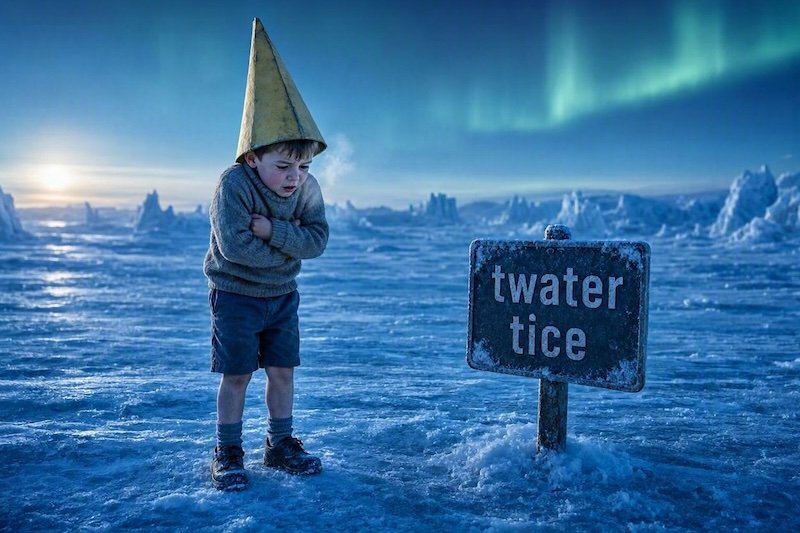
A Fool and a Dunce Walk into a Counterfactual Freezer


I was reading Yablo’s “No Fool’s Cold: Notes on Illusions of Possibility” (That’s not a typo: “Cold”) that continues the theme of modal skepticism when I came up with a radical possibility. Of course, if someone thinks up something in the 21st century it likely has been thought a thousand times before, and this is no different. But let’s start at the beginning and check out whether there is anything new to be discerned.

I might initially think that the contents of my thoughts are the only thing I can truly be confident about since all the world of the senses could be an illusion. Given such a starting point it would be wise to try to understand the relationship between my thoughts and what is perceived by starting with the phenomenon of thought. I immediately become skeptical of my thinking, however, since I am unconscious nearly a third of the day, often accompanied by strange hallucinatory imagery in my dreams. More, I tend to agree with these zombie-intellects who inhabit this society-thing projected on my sensorium-thing and claim to study biases and perceptual trickery. Those perceptual-psychologist-patterns seem right, too, given the number of times I’ve been startled by faces coalescing out of twilight shadows or my overly generous past assessments of my own competency.

Thoughts seem unreliable.

But what is reliable? Some Platonic ideas, geometry, math in general, deductive proofs (uh oh, coarse premises as well as the indeterminacy of synonymy creep in here), and then scientific results (tentatively), perhaps. Let’s take the latter, though, and start with the notion that science contains a methodology that distills out many biases and misperceptions, arriving at a tentative model that is of higher truth value than simple guesses, traditions, and feelings.… Read the rest
The Rubbery Road from Original Position to Metaphysical Naturalism

From complaints about student protests over Israel in Gaza, to the morality of new House Speaker Johnson, and even to the reality and consequences of economic inequality, there is a dynamic conversation in the media over what is morally right and, importantly, why it should be considered right. It’s perfectly normal for those discussions and considered monologues to present ideas, cases, and weigh the consequences to American life, power, and the well-being of people around the world. It also demonstrates the fact that ideas like divine command theory become irrelevant for most if not all of these discussions since they still require secular analysis and resolution. Contributions from the Abrahamic faiths (and similarly from Hindu nationalism) are largely objectionable moral ideas (“The Chosen People,” jihad, anti-woman, etc.) that are inherently preferential and exclusionary.

Indeed, this public dialogue perhaps best shows how modern people build ethical systems. It looks mostly like Rawl’s concept of “reflective equilibrium” with dashes of utilitarianism and occasional influences from religious tradition and sentiment. And reflective equilibrium has few foundational ideas beyond a basic commitment to fairness as justice using the “original position” as its starting point. That is, if we had to create a society with no advance knowledge about what our role and position might be within it (a veil of ignorance), the best for us would be to create an equal, fair, and just society.

So ethics is cognitively rubbery, with changing attachments and valences as we process options into a coherent whole. We might justify civilian deaths for a greater good when we have few options, imprecise weapons, and existential fear (say, the atom bomb in World War II).… Read the rest