Here it is:
Refresh to get the preview…… Read the rest
Here it is:
Refresh to get the preview…… Read the rest
If politics is religion because political theories are not justifiable in any rational sense, then we should expect to find deep theology and apologetics accompanying political “theories.” And we certainly do. Moreover, we should expect that the apologetics gin up mythological frameworks to satisfy prevailing political winds. Social insurance programs are case-and-point. What originated as a scheme to counter the desire to redistribute wealth through a limitation on downward social mobility became synonymous with socialism itself. Elizabeth Anderson of University of Michigan points out the deep ironies in her Chicago Law Dewey lecture on this topic:
The ironies are amplified as we think about the debate over the current health care reform efforts and the flip-flopping of everyone from The Heritage Foundation (note, however, that Heritage denies flip-flopping through an appeal to nuance) to Mitt Romney.
Religion doesn’t care, of course. Religion just requires consistency and a consistent denial of oppositional rhetoric. It also helps to have an enemy, as Ms. Anderson points out. And having cartoon tracts can help, too, as this cartoon embodiment of Freidrich Hayek shows:

The Jehovah’s Witnesses of political theory.… Read the rest
 There is a temptation to be dismissive of “genre fiction” as being merely a fantastical diversion while “serious fiction” and, more relevantly, “realism” retain all of the gravitas that we want to ascribe to writing as an art. And realism must be somehow tied to everyday events because it must be realistic. But what if all art is inevitably bound to artifice in that there is no possibility of chaining a symbolic reference to its ostensible referent?
Thus we chain the crumbling infrastructure of logical positivism to postmodern literature. It is all artifice. There is always a black swan. It is all “mimetic persuasion” (Aristotle channeled through James Wood) where storms of metaphor haloed by limns of allusion and imitation conspire together to push the reader into a caricature of reality that “art…is a disproportioning–(i.e., distorting, throwing out of proportions)–of realities, to show more clearly the features that matter in those realities…” (Thomas Hardy). There is no reality in realism, just the font of imagination that tries to crystallize reality into regularized sheer planes of repetition, of character leitmotivs (oh, poor Proust), of voice, of metaphor, and of estrangement (from Dostoevsky to Nabokov).
We have, then, a bad theory in any scientific sense, where the theory has been overridden time and time again, making psychology look comparatively moored in its modest aspirations. At least psychology is converging with biology. But realism remains subdivided across the aesthetics of literary preference. It lives in fiefs and forts, much like architecture or modern art in general. There is not even local predictability to the grammar of aesthetic change. It may be that theory is not even the right word. Literary theory should be replaced with literary analysis and aesthetics should be untied from the dock of rationalism.… Read the rest
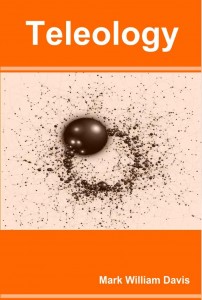 NOTE: In Chapter 29, the protagonist, Harry, has been absorbed into a self-organized artificial world (“The Fabric”) that he created and that treated him as a creator being. Unexpectedly, as a result of a war, Harry’s body is destroyed but his consciousness is copied into a simulation of his own creation. His transmigration is captured by the “Lexis” who revere him but suffer internal schisms that arise alongside their own emerging self-determination.
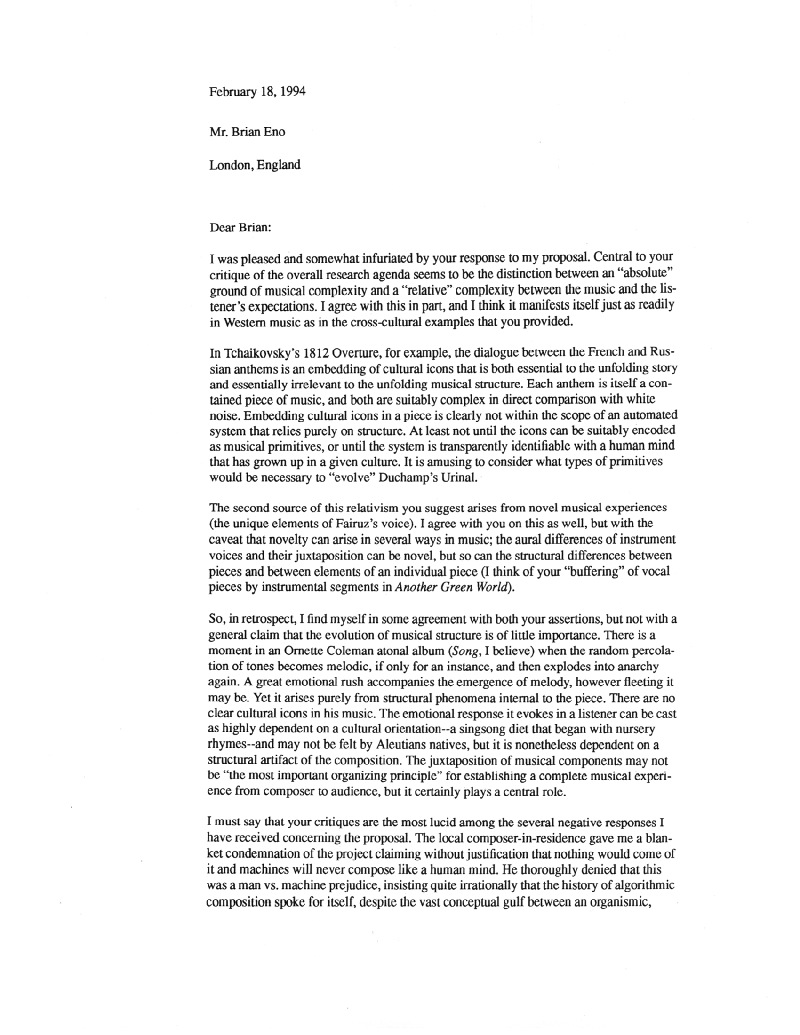
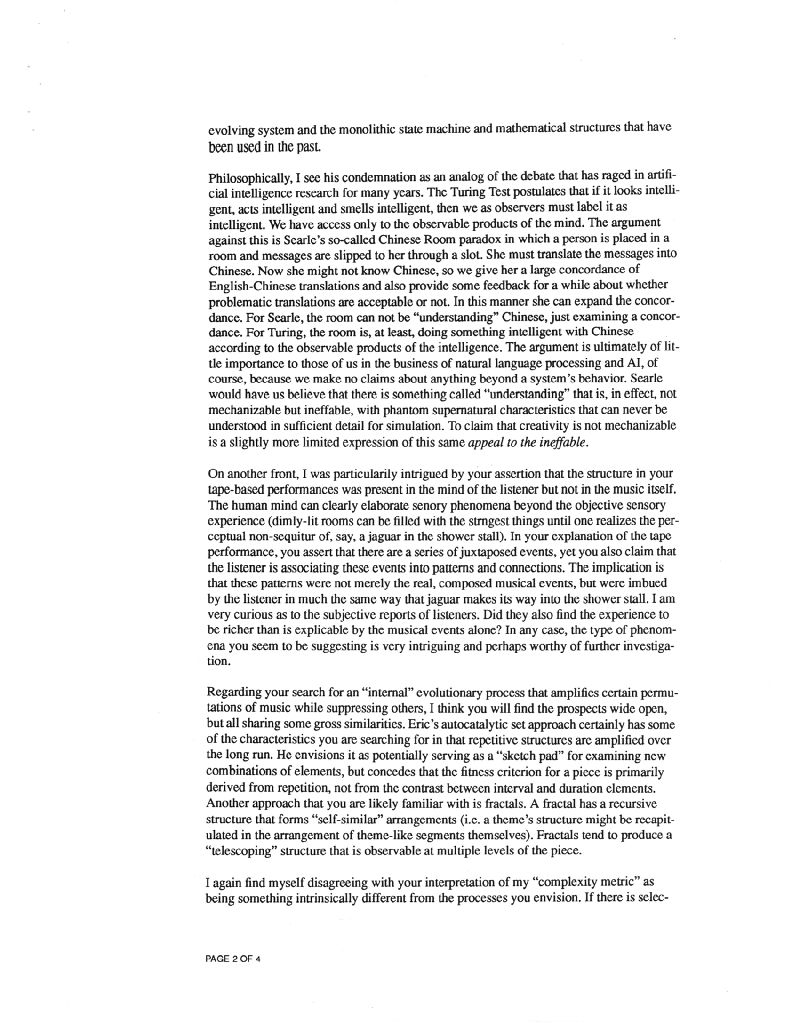
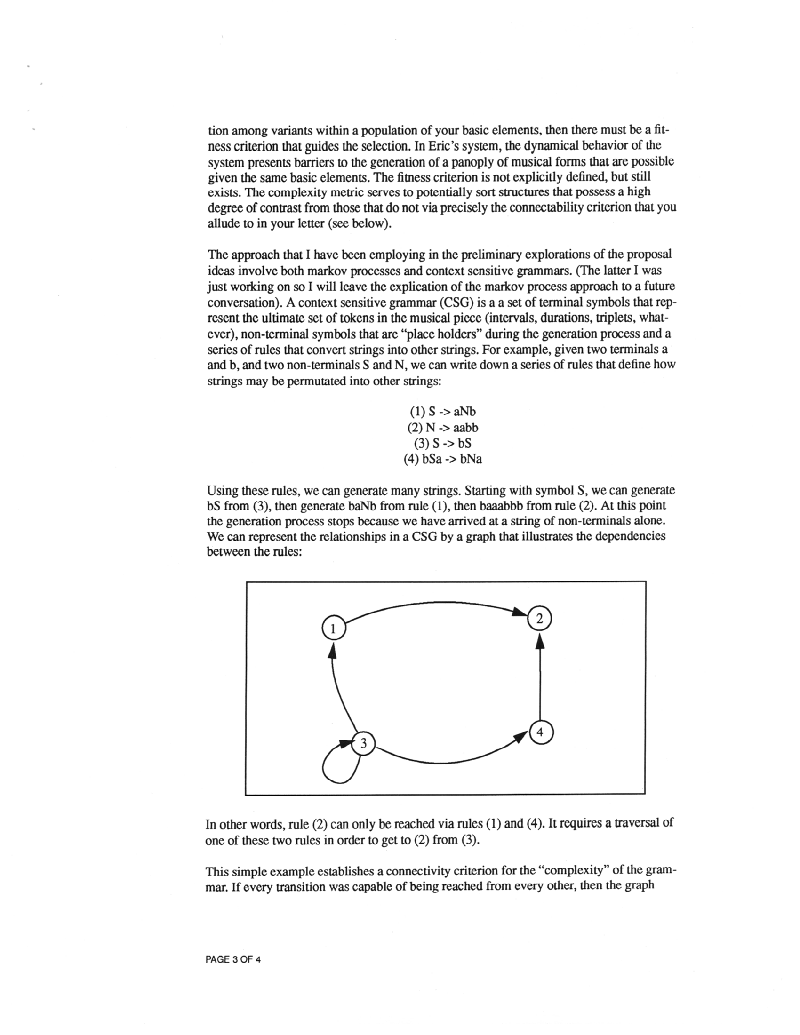
I recently came across an ancient document, older than my son, dating to 1994 when I had a brief FAX-based exchange of communiques with Brian Eno, the English eclectic electronic musician and producer of everything from Bowie’s Low through to U2’s Joshua Tree and Jane Siberry. Eno had been pointed at one of my colleague’s efforts (Eric in the FAXes, below) at using models of RNA replication to create music by the editor of Whole Earth Catalog who saw Eric present at an Artificial Life conference. I was doing other, somewhat related work, and Eric allowed me to correspond with Mr. Eno. I did, resulting in a brief round of FAXes (email was fairly new to the non-specialist in 1994).
I later dropped off a copy of a research paper I had written at his London office and he was summoned down from an office/loft and shook his head in the negative about me. I was shown the door by the receptionist.
Below is my last part of the FAX interchange. Due to copyright and privacy concerns, I’ll only show my part of the exchange (and, yes, I misspelled “Britain”). Notably, Brian still talks about the structure of music and art in recent interviews.
 The weekend came in with skating the tubes under the ghost lights of the nearby self-storage facility until a cop flashed them with his spotlight and they broke up and headed their separate ways. Mom was out until late, drawn into a party thrown by a coworker. Her work, her life. Zach settled in for late night TV and pizza rolls, amused at the banter that had broken out with Belinda on her AetherFaces page. She was a quick wit but needed time to assess her adversary and overcome shyness. Zach decided she was more tiger than sheep. He slipped off another salvo in the repartee, looking forward to meeting her on Saturday.
By midnight he was back in the cave and back shuffling among the servers that were the islands of his Odyssean wanderings. He was poking through an encrypted list of encrypted passwords and targets on a machine somewhere in the financial district of Jakarta when he noticed an IP address that was familiar. It was the basement rack of servers. It came flooding back to him and he realized that he had somehow blanked out the rummaging about in their workings and their connection to The Signal. He logged in and began touching different aspects of the file system. It was all still here, he thought, plunging down through the strange analytical database engine that was cranking out the mathematical filigrees that defined the colored blobs. How had he been enraptured by a process, he wondered, a process that was as unfeeling as a car door? Yet here was the source, the font, the wellspring of the peace he had felt many times. There were bits of blogs cataloged in the server architecture, too, and Zach began parsing out the strange and variegated history of rants and lunatic ramblings.… Read the rest
 What should our expectations be regarding scientific theories? That question regularly bobs to the surface for me. When I taught physics in the Peace Corps over twenty years ago I worried over it. And now, with an inquisitive thirteen-year-old curious about the recent results from the pursuit of the Higgs Boson asking me questions, I continue to think that the conceptual shifts requisite for scientific understanding are perhaps as important as the science itself.
You see, none of it makes simple, clean sense. And none of it makes sense precisely because there is no conceptual similarity between our everyday scales of interaction and those of the mega and the micro. They are baffling and complex and not fully understood. We should take great pride in this, as human beings. We should revel in the rise of experimentation and rationality that has led us to this baffling precipice. We should not back away into the gray simplicity that predates what our scientific investigations have brought us to, because they make enough sense that they can be understood with some effort. But the urge is there; relent at the scale, scope, and complexity of the edifice that is required to get even basic traction. It either doesn’t impact me or is inhuman at some level.
But it needn’t be. The Higgs Boson is simply badly explained because it it based on preserving explanatory footholds that relate to everyday physics of cars and bowling balls. Drop that assumption and things get both weirder and simultaneously simpler. The universe appears to be composed of stuff that has a holographic quality to it in the sense that holograms replicate images throughout their structure. Break a piece off of a hologram and you can still see the image in it.… Read the rest
 I started reading James Wood’s How Fiction Works while on a business trip to the unequivocally nice Orange County or The OC. The trip was less than pleasant for me personally because I apparently tore my rotator cuff earlier in the day while engaged in mildly excessive exercise activities. I say “apparently” because it took me a day or two to figure out what the source of pain really was, living through brief panic waves about what was happening to me while trying to avoid lifting my left arm in a manner that might give away the agony I was experiencing during business meetings.
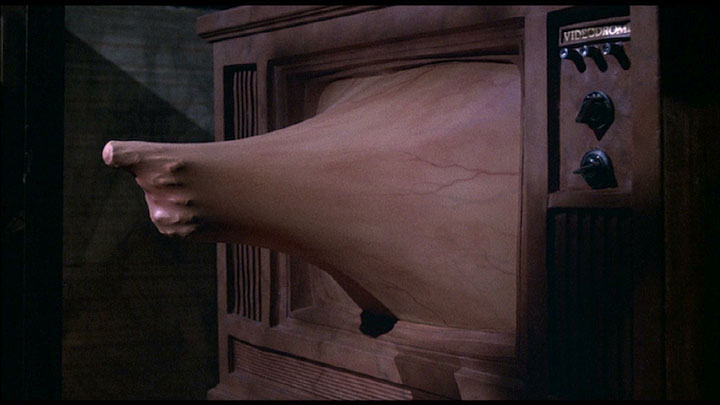
Note that this is the literary critic, James Wood, not the actor, James Woods; not the guy from Videodrome or any of the dozens of ecclectic roles the actor has been associated with.
James Wood, the critic then, is trying to operationalize the vast, categorical shaping of Roland Barthes or Milan Kundera in their efforts at criticism. Wood is not a pure theorist, but a careful reader who looks intimately at texts, unpacking the intent of the writer while defining the historical perspectives that informed the artistic effort. Looking intimately at Flaubert, Wood sees the flaneur of realism that began modernism and led, in turn, to post-modernism. Characters transform from our acquired fog of beloved personalities into flat extensions of English sensibilities in the Theophrastus of Jane Austen, or lurk behind the Russian tradition of estrangement that assigns extravagant and unlikely terminology to everyday things (Nabakov’s “leggy thing” in Pnin), and everywhere is the transition from description to internal dialog that drops the formality of specifying dialog at all. That is modernism. That is realism.… Read the rest
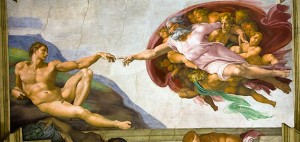 An ever-present flaw in almost all theology and apologetics–and a flaw that is easily remediable–is the requirement for omnipotence, omnibenevolence, and omniscience (OOO) on the part of the structure of God or the gods. We see this in the argumentative doldrums of the Problem of Evil, with practitioners like William Lane Craig and Richard Swinburne building-out elaborate explanatory theodicies in an effort to justify or, at least, allow for an OOO deity. There are extensional consequences, too, like Paul Draper’s argument that an OOO-deity may be obligated to create more than just a single worshipful species given the known extent of the universe.
And what if we remedy the flaw by simply declaring that the OOO assumptions are unnecessary for deities? What if we simply loosen the requirement to something like “God is super-powerful and super-good?” Let’s call this the semi-OOO god theory or SOOO for short. Does SOOO short-circuit the most problematic issues that arise in placing the gods so far above us that we no longer resemble them at all? (an interesting side note: given Christianity’s obsession with the avatar-like character of Christ, it hardly seems aesthetically wrong to assume a flawed God).
The theological and apologetic problems do seem to evaporate, though philosophical arguments evaporate, too:
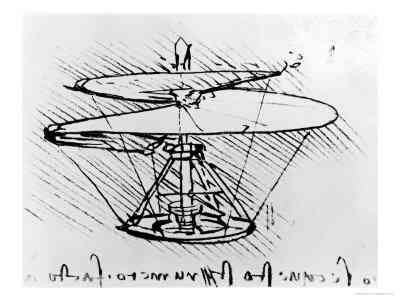 At 38,000 feet somewhere above Missouri, returning from a one day trip to Washington D.C., it is easy to take Nick Bostrom’s point that bird flight is not the end-all of what is possible for airborne objects and mechanical contrivances like airplanes in his paper, How Hard is Artificial Intelligence? Evolutionary Arguments and Selection Effects. His efforts to try to bound and distinguish the evolution of intelligence as either Hard or Not-Hard runs up against significant barriers, however. As a practitioner of the art, finding similarities between a purely physical phenomena like flying and something as complex as human intelligence falls flat for me.
But Bostrom is not taking flying as more than a starting point for arguing that there is an engineer-able possibility for intelligence. And that possibility might be bounded by a number of current and foreseeable limitations, not least of which is that computer simulations of evolution require a certain amount of computing power and representational detail in order to be a sufficient simulation. His conclusion is that we may need as much as another 100 years of improvements in computing technology just to get to a point where we might succeed at a massive-scale evolutionary simulation (I’ll leave to the reader to investigate his additional arguments concerning convergent evolution and observer selection effects).
Bostrom dismisses as pessimistic the assumption that a sufficient simulation would, in fact, require a highly detailed emulation of some significant portion of the real environment and the history of organism-environment interactions:
… Read the restA skeptic might insist that an abstract environment would be inadequate for the evolution of general intelligence, believing instead that the virtual environment would need to closely resemble the actual biological environment in which our ancestors evolved … However, such extreme pessimism seems unlikely to be well founded; it seems unlikely that the best environment for evolving intelligence is one that mimics nature as closely as possible.