Signals and Apophenia

qrcode-distortThe central theme in Signals and Noise is that of the inverse problem and its consequences: given an ocean of data, how does one uncover the true signals hidden in the noise? Is there even such a thing? There’s an obsessive balance between apophenia and modeling somewhere built into our skulls.

The cover art for Signals and Noise reflects those tendencies. There is a QR Code that encodes a passage from the book, and then there is a distortion of the content of the QR Code. The distortion, in turn, creates a compelling image. Is it a fly creeping to the left or a lion’s head tilted to the right?

Yes.

A free hard-cover copy of Signals and Noise to anyone who decodes the QR Code. Post a copy of the text to claim your reward.… Read the rest

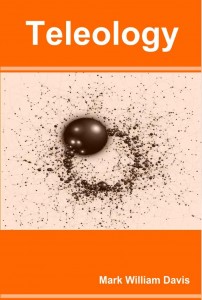
Teleology, Chapter 6

Teleology CoverartThrough that winter, as I recall, Harry became even more involved with the church. I kept my mouth shut about his choices. Mom, sensing that I might be feeling left out, pushed me to get involved in a mentoring program for gifted students after I opened up with my theories about evolutionary simulation and meaning.

My first meeting with my assigned mentor went pretty well, though he intimidated me by not responding immediately to most of what I described. Dr. Korporlik was Serbo-Croatian by ethnicity and had worked for years as a computer scientist and mathematician at the nearby Department of Energy laboratory, Los Alamos, after coming to the US via German laboratories. He was now at a local think tank—the Rio Grande Group—that specialized in studying complex systems. I knew next to nothing about RGG when my school counselor set up my appointment to meet Korporlik. On a crisp November night, Mom drove me to their office building near the downtown plaza. She planned on doing some grocery shopping and left me with instructions to call her if I finished before the allocated hour was up.

Korporlik introduced himself and said he worked on problems in computer science mostly, but that those problems had parallels in biology, and asked what I thought about school.

“It’s OK,” I said.

“Good grades, I think?” he responded.

“Yeah, I get pretty much all As unless I get too bored and then I sometimes get lazy,” I said.

“Yes, it is a common problem. The schools here could be more challenging, yes?” He said rapidly. His accent was fairly thick with chirpy Germanic overtones.

“I guess so. I don’t mind it being easy, I guess.… Read the rest

Hits and MITS

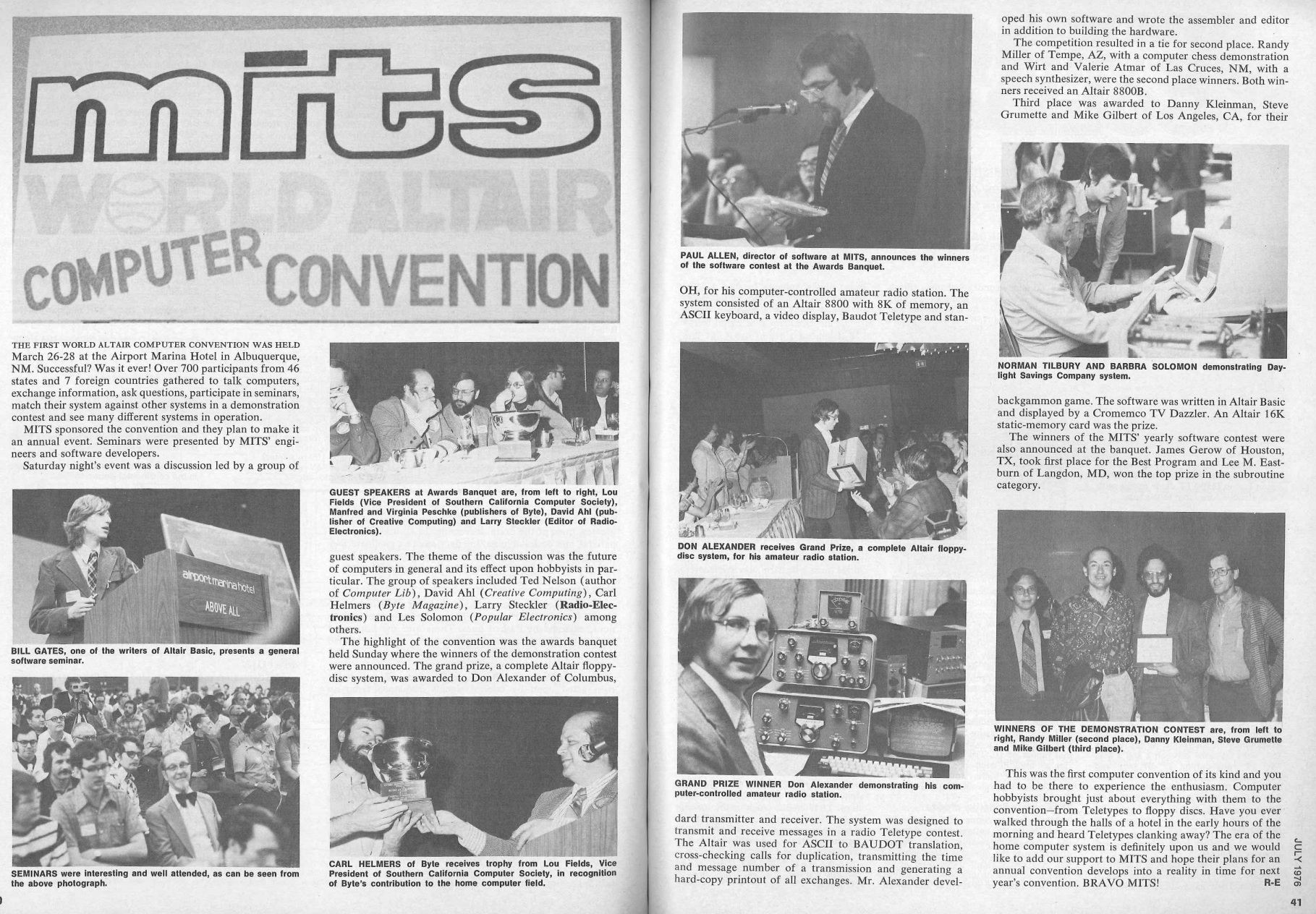
I just came across the following scan that describes how an MITS Altair 8800B became my first personal computer, journeying from Albuquerque to Las Cruces, New Mexico and getting an EEPROM burner attached to a ribbon cable snaking out through the enameled steel case. The speech synthesizer predated stored digital samples, by the way, so it instead emulated phonemic mixtures generated by digital waveform filtering.

And that young chap on the left would later become my boss, three or four parts removed, at Microsoft. I still have that Altair, too, safely stored away.

MITS Altair Convention

Original PDF Scan:

MITS Computer Convention


 … Read the rest

Towards an Epistemology of Uncertainty (the “I Don’t Know” club)

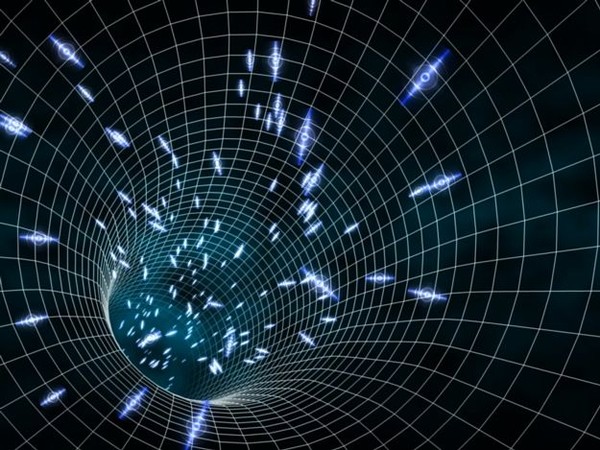
space-timeToday there was an acute overlay of reinforcing ideas when I encountered Sylvia McLain’s piece in Occam’s Corner on The Guardian drawing out Niall Ferguson for deriving Keynesianism from Keynes’ gayness. And just when I was digesting Lee Smolin’s new book, Time Reborn: From the Crisis in Physics to the Future of the Universe.

The intersection was a tutorial in the limits of expansive scientism and in the conclusions that led to unexpected outcomes. We get to euthanasia and forced sterilization down that path–or just a perception of senility when it comes to Ferguson. The fix to this kind of programme is fairly simple: doubt. I doubt that there is any coherent model that connects sexual orientation to economic theory. I doubt that selective breeding and euthanasia can do anything more than lead to inbreeding depression. Or, for Smolin, I doubt that the scientific conclusions that we have reached so far are the end of the road.

That wasn’t too hard, was it?

The I Don’t Know club is pretty easy to join. All one needs is intellectual honesty and earnesty.… Read the rest

Singularity and its Discontents

Kimmel botIf a machine-based process can outperform a human being is it significant? That weighty question hung in the background as I reviewed Jürgen Schmidhuber’s work on traffic sign classification. Similar results have emerged from IBM’s Watson competition and even on the TOEFL test. In each case, machines beat people.

But is that fact significant? There are a couple of ways we can look at these kinds of comparisons. First, we can draw analogies to other capabilities that were not accessible by mechanical aid and show that the fact that they outperformed humans was not overly profound. The wheel quickly outperformed human legs for moving heavy objects. The cup outperformed the hands for drinking water. This then invites the realization that the extension of these physical comparisons leads to extraordinary juxtapositions: the airline really outperformed human legs for transport, etc. And this, in turn, justifies the claim that since we are now just outperforming human mental processes, we can only expect exponential improvements moving forward.

But this may be a category mistake in more than the obvious differentiator of the mental and the physical. Instead, the category mismatch is between levels of complexity. The number of parts in a Boeing 747 is 6 million versus one moving human as the baseline (we could enumerate the cells and organelles, etc., but then we would need to enumerate the crystal lattices of the aircraft steel, so that level of granularity is a wash). The number of memory addresses in a big server computer is 64 x 10^9 or higher, with disk storage in the TBs (10^12). Meanwhile, the human brain has 100 x 10^9 neurons and 10^14 connections. So, with just 2 orders of magnitude between computers and brains versus 6 between humans and planes, we find ourselves approaching Kurzweil’s argument that we have to wait until 2040.… Read the rest

Methodical Play

imageMy fourteen-year-old interviewed a physicist yesterday. I had the privilege of being home over the weekend and listened in; my travel schedule has lately been brutal, with the only saving grace being moments like right now en route to Chicago when I can collapse into reading and writing for a few whitenoise-washed moments. And the physicist who was once his grandfather said some remarkable things:

  • Physics consists of empirical layers of untruth
  • The scientific method is never used as formulated
  • Schools, while valuable, won’t teach how to be a scientist
  • The institutions of physics don’t support the creativity required to be a scientist

Yet there was no sense of anger or disillusionment in these statements, just a framing of the distinctions between the modern social model surrounding what scientists do and the complex reality of how they really do their work.

The positives were that play is both the essential ingredient and the missing determinant of the real “scientific method.” Mess around, try to explain, mess around some more. And what is all that play getting this remarkable octogenarian? Possible insights into the unification of electromagnetism and the strong nuclear force. The interview journey passed from alignment of quarks to the beams of neutron stars, igniting the imaginations of all the minds on the call.

But if there is no real large-scale method to this madness, what might we conclude about the rationality of the process of science? I would advocate that the algorithmic model of inference is perhaps the best (and least biased) way of approaching the issue of scientific method. By constantly reshuffling the available parameters and testing the compressibility of models, play is indistinguishable from science when the play pivots on best explanation.… Read the rest

The Vapors of Hell

Since Plutonium has now been unearthed in Turkey–no, not the element, but the gates of the underworld where the Priests of Cybele got drunk on gases erupting from below the water table–it seems only appropriate to trace the historic, mythic, and semantic roots of the notion of Hell out from its roots in antiquity straight through to our modern representations.

We can draw a direct line from Tartarus to the concept of punishment and the afterlife that arose during the Hellenistic period and filtered into the Near East, and what better representation of the dangerous threats from deep beneath the earth than a cave that kills animals and makes people drunk on the fumes? Such a place must have captivated the minds of the ancients by providing a corporeal connection to the mythic dancing of the deities.

The great irony is that the Hierapolis and the Plutonium was bulldozed by Christians in the 4th to 6th century CE, thus destroying a touchstone of their own cosmology.… Read the rest

Signals and Noise: Chapter 00010101 (Ennui)

cover-design-epubWhat does one do when one is only living? What does one do when there is nothing to be done. Waking back to the abandoned reactor was already boring after only one night. It was late in the morning judging from the portals of light in the hall outside his cell. He was famished and athirst as he walked down to the central room. Only a few children milled between smoldering fires. He could smell food, though, and followed the scent. It was bacon, he thought, and his mouth began salivating. He hardly ever ate bacon, but he often craved it. He found older kids cooking in a functioning kitchen, though they had converted the sinks into fire pits and were toasting bread and frying bacon in iron skillets thrust into the hot coals. He waited in line for a helping and gobbled it down with his hands off the tin plate that they handed him. He looked behind the cooks and saw several large, blue coolers filled with milk cartons, eggs, and slabs of meat on top of mounds of ice. Zach thought that they must have brought that in this morning since there was no electricity at the facility.

A boy approached him as he leaned against a wall and drank deeply from the cup of milk that he had been given. You a hacker? the boy asked, stammering and averting his gaze just a bit as he spoke, then raising his eyes directly towards Zach until Zach returned the look. Yeah, I spose. Why? Oh, dunno. I’ve never touched a puter, he said, seeming proud of his accomplishment. Really? Zach asked. How long you been here? The boy grinned at him.… Read the rest

Curiouser and Curiouser

georgeJürgen Schmidhuber’s work on algorithmic information theory and curiosity is worth a few takes, if not more, for the researcher has done something that is both flawed and rather brilliant at the same time. The flaws emerge when we start to look deeply into the motivations for ideas like beauty (is symmetry and noncomplex encoding enough to explain sexual attraction? Well-understood evolutionary psychology is probably a better bet), but the core of his argument is worth considering.

If induction is an essential component of learning (and we might suppose it is for argument’s sake), then why continue to examine different parameterizations of possible models for induction? Why be creative about how to explain things, like we expect and even idolize of scientists?

So let us assume that induction is explained by the compression of patterns into better and better models using an information theoretic-style approach. Given this, Schmidhuber makes the startling leap that better compression and better models are best achieved by information harvesting behavior that involves finding novelty in the environment. Thus curiosity. Thus the implementation of action in support of ideas.

I proposed a similar model to explain aesthetic preferences for mid-ordered complex systems of notes, brush-strokes, etc. around 1994, but Schmidhuber’s approach has the benefit of not just characterizing the limitations and properties of aesthetic systems, but also justifying them. We find interest because we are programmed to find novelty, and we are programmed to find novelty because we want to optimize our predictive apparatus. The best optimization is actively seeking along the contours of the perceivable (and quantifiable) universe, and isolating the unknown patterns to improve our current model.… Read the rest

Minimizing Existential Toaster Threats

tesla2Philosophy in the modern world has strived for a sense of relevance as the sciences (“natural philosophy”) have become dominant. But philosophy may have found a footing in the complicated space between technological advances and defining human virtues with efforts to address and understand change and its impact on human existence. These efforts have included the ethics of biological manipulation and, critically, existential threats to humanity, including climate change, artificial intelligence, and genetic engineering.

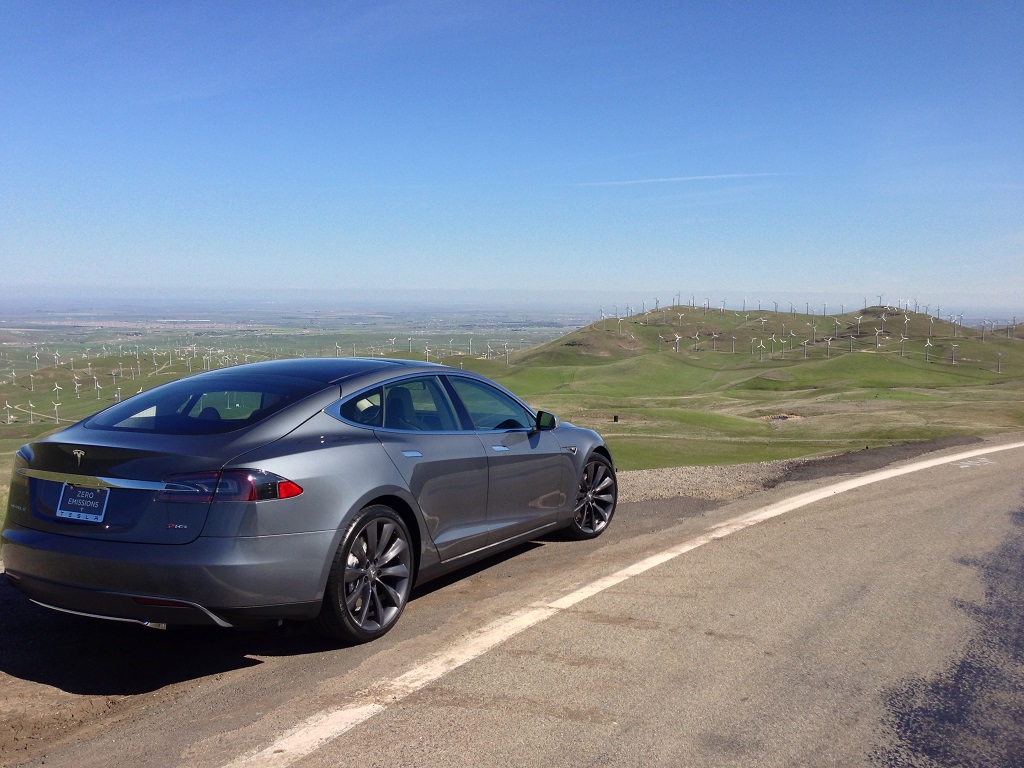
I mention all this because I’m really writing about cars but need to fit the discussion somehow into the theme of this blog. So the existential threat of climate change means we need to pollute less and burn less fossil fuels. More tactically, however, my wife and I also needed to buy a new toaster because our five-year-old Oster four-burner unit was failing. There was therefore only one solution to this dilemma: take the brand new Tesla S 70 miles away to the foothills of the Sierra on a test drive and, yes, to buy a new toaster.

I had taken delivery of our Tesla S Performance 85 with Tech Package a week before but didn’t really have any opportunity to drive it because of work obligations that kept me firmly planted in front of a computer monitor. I had driven it briefly but it mostly sat charging in the garage (at the slowish pace of a 120V circuit; Tesla did not deliver my dual charger station in time and I haven’t had the 100A circuit installed to support it either), so when Saturday came, I realized that it was an opportunity to justify a longish trek to test the drivability of the car and to seek out and use the Tesla “supercharger” stations that promise rapid charging in 30 minutes to an hour.… Read the rest