Euhemerus and the Bullshit Artist

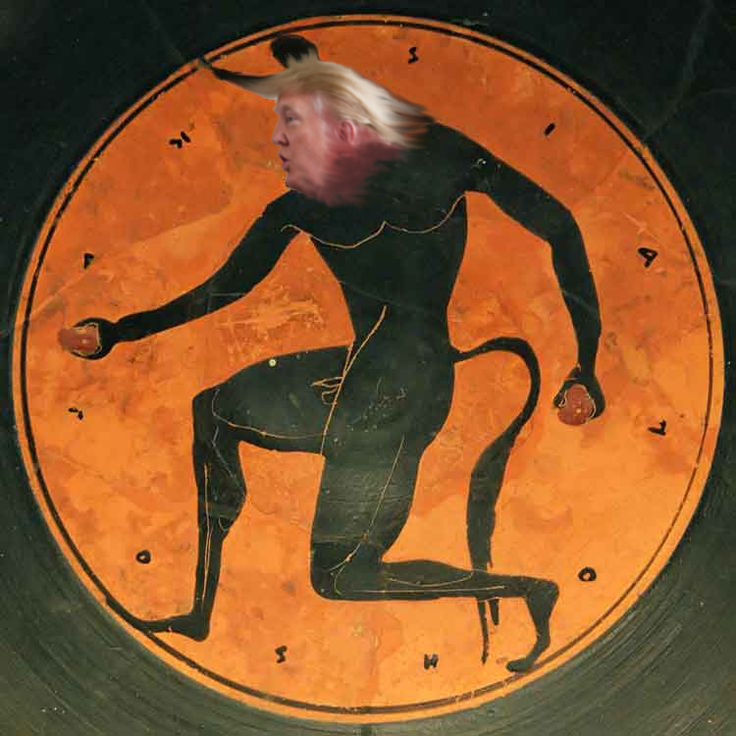
trump-minotaurSailing down through the Middle East, past the monuments of Egypt and the wild African coast, and then on into the Indian Ocean, past Arabia Felix, Euhemerus came upon an island. Maybe he came upon it. Maybe he sailed. He was perhaps—yes, perhaps; who can say?—sailing for Cassander in deconstructing the memory of Alexander the Great. And that island, Panchaea, held a temple of Zeus with a written history of the deeds of men who became the Greek gods.

They were elevated, they became fixed in the freckled amber of ancient history, their deeds escalated into myths and legends. And, likewise, the ancient tribes of the Levant brought their El and Yah-Wah, and Asherah and Baal, and then the Zoroastrians influenced the diaspora in refuge in Babylon, until they returned and had found dualism, elemental good and evil, and then reimagined their origins pantheon down through monolatry and into monotheism. These great men and women were reimagined into something transcendent and, ultimately, barely understandable.

Even the rational Yankee in Twain’s Connecticut Yankee in King Arthur’s Court realizes almost immediately why he would soon rule over the medieval world as he is declared a wild dragon when presented to the court. He waits for someone to point out that he doesn’t resemble a dragon, but the medieval mind does not seem to question the reasonableness of the mythic claims, even in the presence of evidence.

So it goes with the human mind.

And even today we have Fareed Zakaria justifying his use of the term “bullshit artist” for Donald Trump. Trump’s logorrhea is punctuated by so many incomprehensible and contradictory statements that it becomes a mythic whirlwind. He lets slip, now and again, that his method is deliberate:

DT: Therefore, he was the founder of ISIS.

Read the rest

Against Superheroes: Section 18 (Chapter 15)

Against SuperheroesThe sessions with Sakara were illuminative and intimate. She asked me about what I remembered from before the transformation. I sat in the chair across from her, the susurration of the air conditioning that seemed to feed the field projectors as much as our comfort was a constant presence beneath our discussion. I remembered very little: hints of childhood, more about the dig at Mt. Hasan, bits of Ela’s sexual mystique, strange flashes of schools and lights. Interrogating this past revealed very little new or surprising to me. I was candid about my limitations concerning the changes to my memory. I was also candid about how with the loss of a personal history came, inevitably, a loss of the essentials of being human. We are continuitities of experience. I can’t describe who I am except as part of my memories and the feelings that surround and enervate them. The protracted calamity of religious ideas that Sakara raised, from ethical concerns about harming others to the status of the unborn all unravel with this consideration. A baby is alive but only tentatively human in the strongest sense. A god knows this—can even feel it as a ribbon into the future—but humans just arbitrarily assign categories that are driven by misunderstandings of these cognitive postures.

Why were the gods so capricious, she asked me. Why were they so inhuman? They were good human questions but the answer hardly raised above this faint echo of incapacity. If your mind is subsumed in this web of temporal flux, if you recognize the flammability of experience, and where there are other islands of experiences too, like for a human that there is only instead a moving arc of intransitive expectations and plans, then what is left is the broader permamence of an ineffable now.… Read the rest

Against Superheroes, Section 7 (Chapter 5)

coverar-v3-2-10-2015Section 7

With Chapter 4 we see a combination of narrative forms. There is, first, the factual discussion of the details of the archaeological dig itself. There are the problems that arise from the details of the ground, the water, the shaft, the descent. These problems and the detailed resolution of them lend to a sense of consistent realism concerning the tasks at hand in the everyday lives of the protagonists. The level of detail is strikingly at odds with the other primary narrative form: Sinister’s soliloquy on the symbolism and history of other deities. The position of these paragraphs juxtaposed amongst the more detailed discussion has produced several potential explanations, the most important of which was the requirement for presaging the unknown technology and its role in past conflicts. While there is an element of that, as a memoir presenting a linear sequence of developments (remember that he was concerned about that presentation), it is equally plausible that his recollections were merely jumbled and possessed of a certain confused emotional state.

The content of the soliloquy is worth further analysis. The primary descriptions are of conquest of people and their gods against others. There is a spreading out of the various factions, Hellenists, Israelites, Romans, etc. They are constantly at war with one another and the more powerful gods subjugate the less powerful. The subtle indication that amongst at least some of them, the Hellenists, that the gods were somewhat distant to them is of particular interest because it begs the question of how, amongst all the spirits and entities that are referenced, they were applied during war? What means of attack and influence did they have that apparently led to them conquering Yahweh and others?… Read the rest

The Rise and Triumph of the Bayesian Toolshed

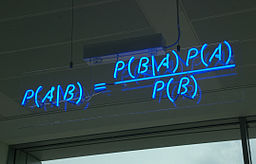
Bayes LawIn Asimov’s Foundation, psychohistory is the mathematical treatment of history, sociology, and psychology to predict the future of human populations. Asimov was inspired by Gibbon’s Decline and Fall of the Roman Empire that postulated that Roman society was weakened by Christianity’s focus on the afterlife and lacked the pagan attachment to Rome as an ideal that needed defending. Psychohistory detects seeds of ideas and social movements that are predictive of the end of the galactic empire, creating foundations to preserve human knowledge against a coming Dark Age.

Applying statistics and mathematical analysis to human choices is a core feature of economics, but Richard Carrier’s massive tome, On the Historicity of Jesus: Why We Might Have Reason for Doubt, may be one of the first comprehensive applications to historical analysis (following his other related work). Amusingly, Carrier’s thesis dovetails with Gibbon’s own suggestion, though there is a certain irony to a civilization dying because of a fictional being.

Carrier’s methods use Bayesian analysis to approach a complex historical problem that has a remarkably impoverished collection of source material. First century A.D. (C.E. if you like; I agree with Carrier that any baggage about the convention is irrelevant) sources are simply non-existent or sufficiently contradictory that the background knowledge of paradoxography (tall tales), rampant messianism, and general political happenings at the time lead to a likelihood that Jesus was made up. Carrier constructs the argument around equivalence classes of prior events that then reduce or strengthen the evidential materials (a posteriori). And he does this without ablating the richness of the background information. Indeed, his presentation and analysis of works like Inanna’s Descent into the Underworld and its relationship to the Ascension of Isaiah are both didactic and beautiful in capturing the way ancient minds seem to have worked.… Read the rest

On Killing Kids

Mark S. Smith’s The Early History of God is a remarkable piece of scholarship. I was recently asked what I read for fun and had to admit that I have been on a trajectory towards reading books that have, on average, more footnotes than text. J.P. Mallory’s In Search of the Indo-Europeans kindly moves the notes to the end of the volume. Smith’s Chapter 5, Yahwistic Cult Practices, and particularly Section 3, The mlk sacrifice, are illuminating on the widespread belief that killing children could propitiate the gods. This practice was likely widespread among the Western Semitic peoples, including the Israelites and Canaanites (Smith’s preference for Western Semitic is to lump the two together ca. 1200 BC because they appear to have been culturally the same, possibly made distinct after the compilation of OT following the Exile).

I recently argued with some young street preachers about violence and horror in Yahweh’s name and by His command while waiting outside a rock shop in Old Sacramento. Human sacrifice came up, too, with the apologetics being that, despite the fact that everyone was bad back then, the Chosen People did not perform human sacrifice and therefore they were marginally better than the other people around them. They passed quickly on the topic of slavery, which was wise for rhetorical purposes, because slavery was widespread and acceptable. I didn’t remember the particulars of the examples of human sacrifice in OT, but recalled them broadly to which they responded that there were translation and interpretation errors with “burnt offering” and “fire offerings of first borns” that, of course, immediately contradicted their assertion of acceptance and perfection of the scriptures.

More interesting, though, is the question of why might human sacrifice be so pervasive, whether among Yahwists and Carthiginians or Aztecs?… Read the rest

Language Games

Word GamesOn The Thinking Atheist, C.J. Werleman promotes the idea that atheists can’t be Republicans based on his new book. Why? Well, for C.J. it’s because the current Republican platform is not grounded in any kind of factual reality. Supply-side economics, Libertarianism, economic stimuli vs. inflation, Iraqi WMDs, Laffer curves, climate change denial—all are grease for the wheels of a fantastical alternative reality where macho small businessmen lift all boats with their steely gaze, the earth is forever resilient to our plunder, and simple truths trump obscurantist science. Watch out for the reality-based community!

Is politics essentially religion in that it depends on ideology not grounded in reality, spearheaded by ideologues who serve as priests for building policy frameworks?

Likely. But we don’t really seem to base our daily interactions on rationality either. 538 Science tells us that it has taken decades to arrive at the conclusion that vitamin supplements are probably of little use to those of us lucky enough to live in the developed world. Before that we latched onto indirect signaling about vitamin C, E, D, B12, and others to decide how to proceed. The thinking typically took on familiar patterns: someone heard or read that vitamin X is good for us/I’m skeptical/why not?/maybe there are negative side-effects/it’s expensive anyway/forget it. The language games are at all levels in promoting, doubting, processing, and reinforcing the microclaims for each option. We embrace signals about differences and nuances but it often takes many months and collections of those signals in order to make up our minds. And then we change them again.

Among the well educated, I’ve variously heard the wildest claims about the effectiveness of chiropractors, pseudoscientific remedies, the role of immunizations in autism (not due to preservatives in this instance; due to immune responses themselves), and how karma works in software development practice.… Read the rest

The Vapors of Hell

Since Plutonium has now been unearthed in Turkey–no, not the element, but the gates of the underworld where the Priests of Cybele got drunk on gases erupting from below the water table–it seems only appropriate to trace the historic, mythic, and semantic roots of the notion of Hell out from its roots in antiquity straight through to our modern representations.

We can draw a direct line from Tartarus to the concept of punishment and the afterlife that arose during the Hellenistic period and filtered into the Near East, and what better representation of the dangerous threats from deep beneath the earth than a cave that kills animals and makes people drunk on the fumes? Such a place must have captivated the minds of the ancients by providing a corporeal connection to the mythic dancing of the deities.

The great irony is that the Hierapolis and the Plutonium was bulldozed by Christians in the 4th to 6th century CE, thus destroying a touchstone of their own cosmology.… Read the rest

Hirsi Ali’s Social Evolution

Ayaan Hirsi Ali reminds us of the depressingly anti-freedom recent history of Islam in her recent Newsweek article, Muslim Rage & The Last Gasp of Islamic Hate. For Hirsi Ali, despite fatwas on Rushdie, 9/11, and the murder of  her friend and collaborator, Theo von Gogh, a kernel of hope is nascent in the democracy movements that emerged from the Arab Spring: when people have to govern themselves they will, ultimately, turn towards freedom of expression, thought, and worship.

But is that hope warranted?

Is there any sense of inevitability to the liberal programme that emerged from industrialization, affluence, and education? Or is the “progress” of the West more contingent than that, built from happenstance due to the geographic separation of America from Germany and Japan in World War II combined with the widespread availability of raw materials on the American continent, leading to success in that war and the growth of American post-War power in an unbombed industrial landscape that, ironically, led in turn to the defeat of Soviet Communism, itself claiming an inevitability to the flow of history?

Azar Gat raised a parallel question in The Return of Authoritarian Great Powers (Foreign Affairs, 86 (4), pp. 59-69) when he asked whether the rise of “Authoritarian Capitalism” in the form of China and recent Russia constitutes a viable challenge to the claims of liberal democracy. If so, then the notion that there is any sense of inevitability evaporates like the suppositions of dialectical materialism.

The underlying assumptions are taken for granted among most Americans: (1) all people are the same; (2) all people want freedom; (3) authoritarianism is anti-freedom; (4) people will oppose authoritarianism. It’s a nice thought that has some resonance in, say, the history of the Eastern Block, where economic limitations combined with cronyism and foreign political control led to (4).… Read the rest

The Evolution of American Gods

Taking a break from my countdown, Simon Critchley is back in the New York Times with his fascinating analysis of Mormonism and the varied doctrines concerning reincarnation and the eventual divinity of, well, at least men. Interestingly, reading The Book of Mormon doesn’t illuminate these topics–they exist largely as exegesis through specific lectures by Joseph Smith. As Critchley notes about Smith’s lecture, the character and nature of God is finite, is a member of the Host of Heaven (or a council per the lecture), and creation in Genesis is not creation per se, but is instead some kind of reorganization of an infinite and timeless universe.

Fascinatingly strange, and compounded in its strangeness by the assertion that:

The mind or the intelligence which man possesses is co-equal [co-eternal] with God himself.

It is an evolutionary assertion that suggests our ultimate being is a divine form, and that we have the capacity to achieve this divinity through action, through works, and through effort at being good. As Critchley concludes:

…I see Joseph Smith’s apostasy as strong poetry, a gloriously presumptive and delusional creation from the same climate as Whitman, if not enjoying quite the same air quality. Perhaps Mormonism is not so far from romanticism after all. To claim that it is simply Christian is to fail to grasp its theological, poetic and political audacity. It is much more than mere Christianity.

While I doubt that this analysis will help assuage the concerns of conservative Christians about Mitt Romney’s faith, it undoubtedly serves as a touchstone for that uniquely American principle of religious freedom, and the underlying assumption (on Constitution Day), that the choice of a leader should not be tied to their choice of romantic delusions.… Read the rest

Cosmological Interregnum

Zach, the main character in Signals and Noise, finds himself fascinated by cosmology because it is the only thing that takes him outside of everyday reality into a realm that is alien and mysterious. Biology is reconcilable to our personal lives, law is a linguistic game, computer science is second-hand to Zach, the complex mathematics of the titular “Signal” is discoverable in intent if not details, but cosmology asks questions that cross into a metaphysical realm. Unlike religious feeling, however, there is no requirement of faith and no direct application to human interactions. There is no ethics of cosmology and little human history.

Should we have expected this? Should we have expected a universe that has black holes or neutrinos? We currently believe that the universe is expanding and may expand forever into a cold, diffuse conclusion. Dark matter and dark energy have to be invoked to explain this and the clumping we observe in the universe. But, interestingly, tiny little particles called neutrinos may be a large portion of this dark matter. Neutrinos have tiny mass and behave somewhat like photons passing through translucent materials when they pass through matter, but they change forms during transit according to an interesting interaction with matter known as “flavor oscillations.”

While the Catholic Church uses cosmology to justify ex nihilo creation, there is almost nothing in modern cosmology that justifies or supports religious sentiments, whether Western or Eastern. Indeed, this is just plain weird shit that devolves out of mathematical results and then is confirmed or denied by experimental methods (with a bias towards the confirmed results).

Zach is more than justified. He is right in his fascination and his skepticism about merely human ideologies.… Read the rest