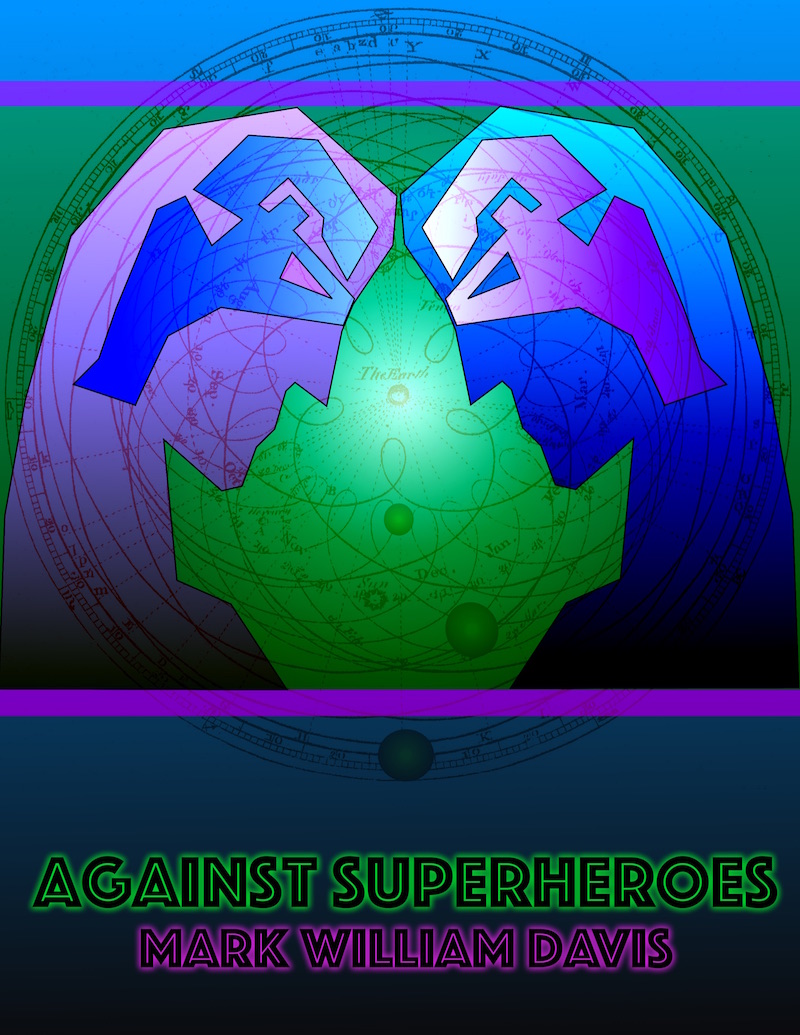
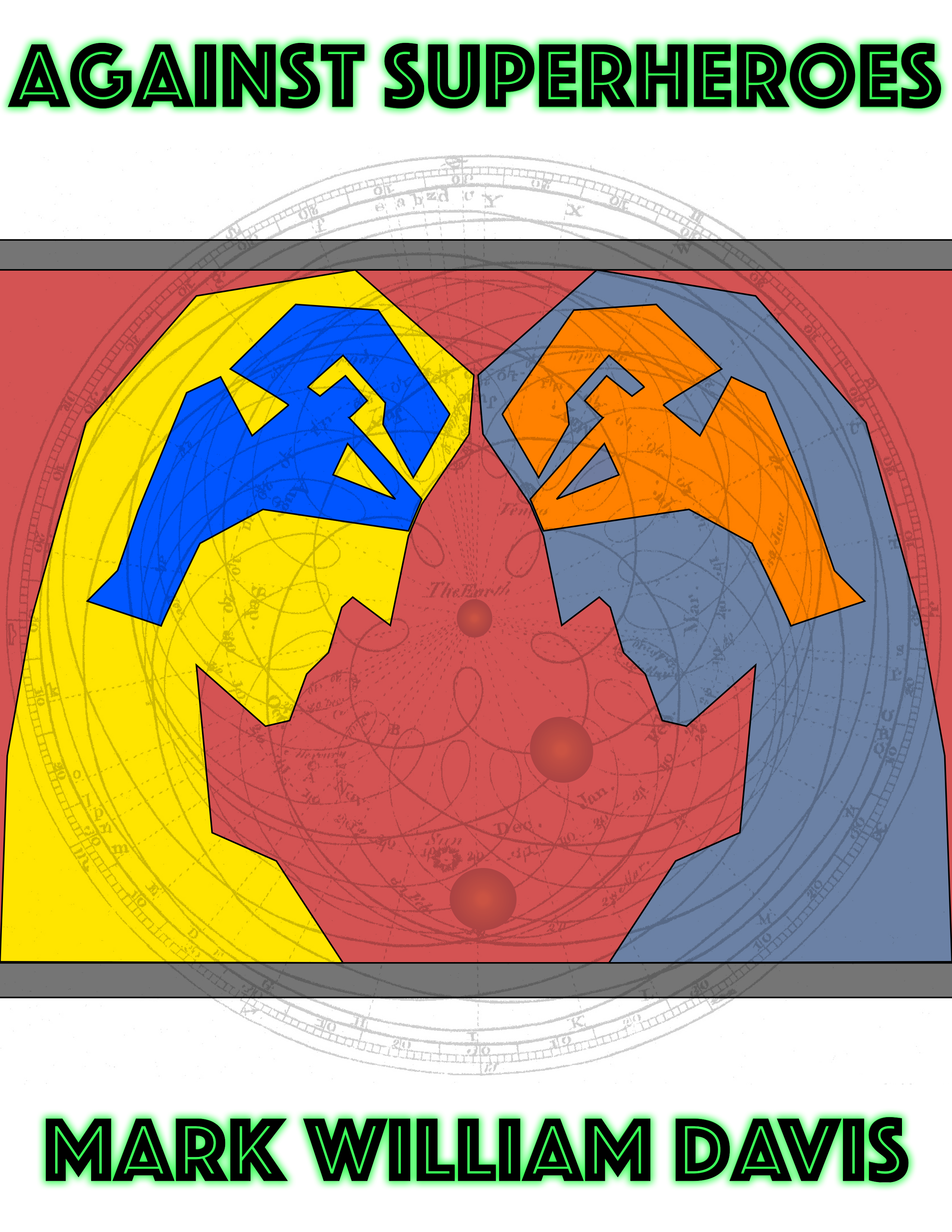
Some new cover options for Against Superheroes are below. The previous, darker option remains front and center based on initial focus groups:
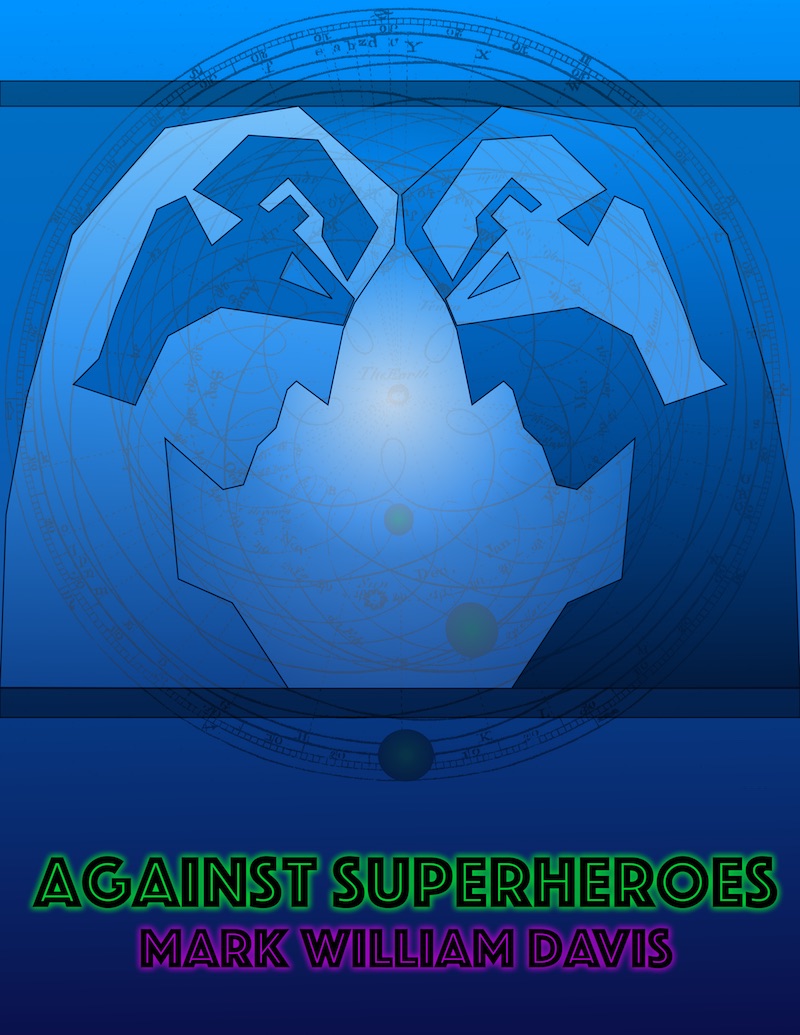
Some new cover options for Against Superheroes are below. The previous, darker option remains front and center based on initial focus groups:
 I just did a victory lap around wooden columns in my kitchen and demanded high-fives all around: Against Superheroes is done. Well, technically it just topped the first hurdle. Core writing is complete at 100,801 words. I will now do two editorial passes and then send it to my editor for clean-up. Finally, I’ll get some feedback from my wife before sending it out for independent review.
I try to write according to a daily schedule but I have historically been an inconsistent worker. I track everything using a spreadsheet and it doesn’t look pretty:
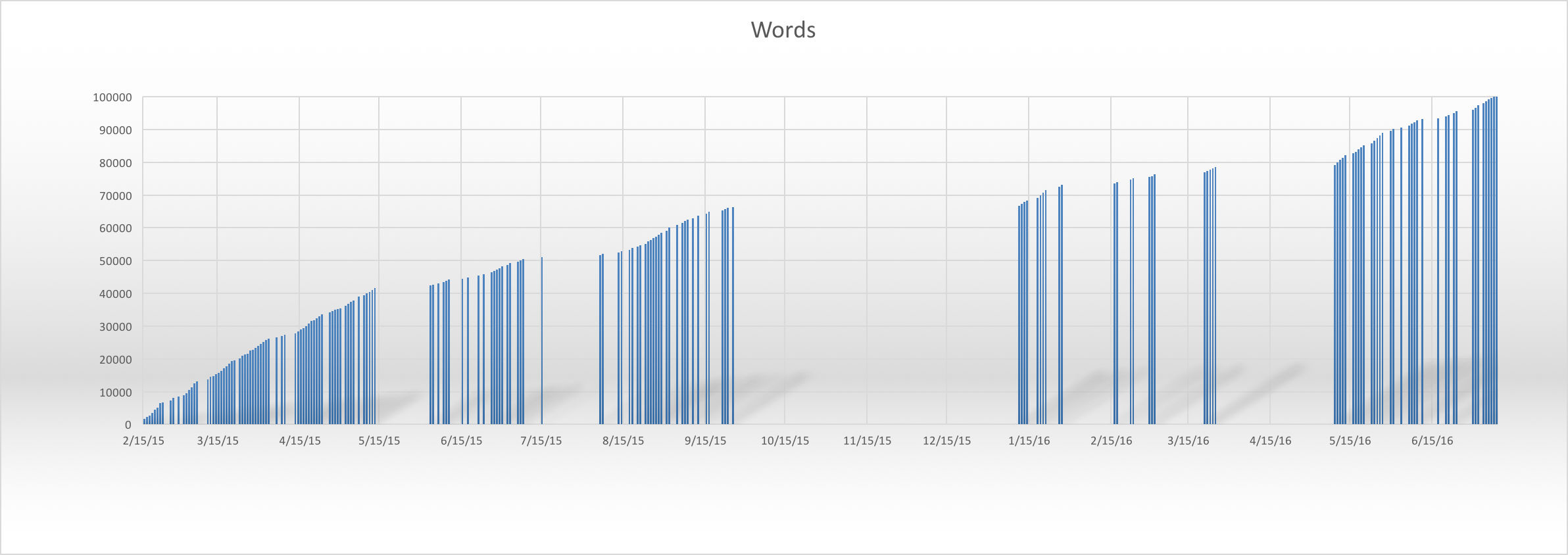
Note the long gaps. The gaps are problematic for several reasons, not the least of which is that I have to go back and read everything again to return to form. The gaps arrive with excuses, then get amplified by more excuses, then get massaged into to-do lists, and then always get resolved by unknown forces. Maybe they are unknowable.
The one consistency that I have found is that I always start strong and finish strong, bursts of enthusiasm for the project arriving with runner’s high on the trail, or while waiting in traffic. The plot thickets open to luxuriant fields. When I’m in the gap periods I distract myself too easily, finding the deep research topics an easy way to justify an additional pause of days, then weeks, sometimes months.
I guess I should resolve to find my triggers and work to overcome these tendencies, but I’m not certain that it matters. There is no rush, and those exuberant starts and ends are perhaps enough of a reward that no deeper optimization of my soul is needed.… Read the rest
On the 21st of June, 1997, which was the solstice, my wife and I married. We celebrated that date again today, but it is not the solstice again due to astronomical drift around the calendar. And I also crossed the border of 100,000 words on Against Superheroes, moving towards resolution of a novel that could, conceivably, have no ending. There are always more mythologies to be explored.
Just last week I was in Banff, Canada, sitting quietly with my bear spray and a little titanium cook pot. I didn’t have to deploy the mace, and was relieved I also didn’t have to endure twelve hours of wolf stalking like this Canadian woman.
And while I was north of the US border, I learned that a Canadian animated film I was involved with was released to Amazon Prime video. I am just an Executive Producer of the film, which means that I had no creative input, but I am really pleased with the film. Ironically, I couldn’t watch this Canadian product while in Canada, just an hour from the studio that produced it. But rest assured that Christmas will be saved in the end!… Read the rest
The twin horns, the god dilemma. In retrospect, for that period and the aberrancy that flowed through my mind, there remained a small piece of me that was grounded in the sad derelicts of my moral constructions. Could I simply be moral because I was a god? Or was the moral order external to me making me irrelevant. Irrelevant or arbitrary. I reflect now, under some control, on my perverse desires during that period (really they never left me but were just suppressed and—what is the term?—sublimated into other actions). But perhaps that is the very nature of the trajectory I was on: the breakdown and atomization of my soul or personality, and the reconstruction of it like some child emerging from the jungle, biting fellow kindergartners, until the rough edges of her being are chiseled off by running the complex maze of sharp-cornered lessons. I had been reborn and was still the wolf child.
The mythologies I was trained in tell me only sometimes about the growth of gods from childhood. Endymion, Bellerophon, Baal and Anat, they all emerge without any sense of tempest in their birth or any period of maturation. Even Jesus was born, revered, and then was spreading the word of his own godliness without any explication about the transitional period. I can only imagine the difficulty of raising that boy, whether he was arrogant towards his mother and stepfather or was stinking of zen, as the Japanese would say, so holier than thou that mother and father just suppressed contempt until the little carpenter was old enough to be thrust out into the world.
There was an intensity to the feeling and beliefs during the transformation, a rising up of what might be translated as pride, but a pride that was baseless, having been sucked of all the historical content of achievements and accolades that might result in pride.… Read the rest
The sessions with Sakara were illuminative and intimate. She asked me about what I remembered from before the transformation. I sat in the chair across from her, the susurration of the air conditioning that seemed to feed the field projectors as much as our comfort was a constant presence beneath our discussion. I remembered very little: hints of childhood, more about the dig at Mt. Hasan, bits of Ela’s sexual mystique, strange flashes of schools and lights. Interrogating this past revealed very little new or surprising to me. I was candid about my limitations concerning the changes to my memory. I was also candid about how with the loss of a personal history came, inevitably, a loss of the essentials of being human. We are continuitities of experience. I can’t describe who I am except as part of my memories and the feelings that surround and enervate them. The protracted calamity of religious ideas that Sakara raised, from ethical concerns about harming others to the status of the unborn all unravel with this consideration. A baby is alive but only tentatively human in the strongest sense. A god knows this—can even feel it as a ribbon into the future—but humans just arbitrarily assign categories that are driven by misunderstandings of these cognitive postures.
Why were the gods so capricious, she asked me. Why were they so inhuman? They were good human questions but the answer hardly raised above this faint echo of incapacity. If your mind is subsumed in this web of temporal flux, if you recognize the flammability of experience, and where there are other islands of experiences too, like for a human that there is only instead a moving arc of intransitive expectations and plans, then what is left is the broader permamence of an ineffable now.… Read the rest
Back among the Western minds, first in Iceland and then his home country of America, living under a cloak of pretense, Sinister appears more human than ever since his transformation. We note that he has taken on a rather different engagement with his powers that is more nuanced and self-reflective. The gradual transformation from an undiluted, power-mad self into this new form operates at several different levels. First there are the physical transformations that ultimately recompose him into his human form. Then there are the mental acrobatics that allow a new sense of self to emerge out of the rubble of the tempestuous being that drove events at Oasis.
We take a moment to try to correlate his rather detailed descriptions of the nature of his powers with known current technologies. He describes the physical world as collections of particles that have deterministic trajectories, for example, and describes his engagement with those particles as affecting that determinism to change both material things as well as affect the “neural” structure of humans themselves. Other Collectives have weighed in on how precisely this technology might work, but the general conclusion is that it closely resembles the bio-essence fields of levels 2 and 3, as well as their control. His misunderstanding of how the technology works is quite understandable; he lacked the educational context that we have.
It is important to consider his statements within the broad contours of his primitive worldview. He views the world as fundamentally composed of small components of material things (atoms and molecules), and he also conceives of mental function as derivative of the motions of these things. We know this to be a primitive and fundamentally bizarre way of comprehending reality.… Read the rest
 Well the title is a mouthful, yet it relates to an article in The Guardian concerning the literary significance of role-playing games. Norway’s Aarseth coined the term “ergodic” to describe literary systems that evolve according to the choices of the reader/player.
First, this is just incorrect. Ergodic has a very specific meaning in thermodynamics. Ergodic means that the temporal evolution of a system will be random and irreversible. Aarseth takes the Greek meanings too literally choosing to equate the ergo (work) and hodos (path) with the temporal evolution of hypertexts (where one chooses the next step) or RPGs (where players choose the next steps but there may be random decisions dictated by dice roles). He also likes the term “cybernetic” which was literally “pilot” and was given its modern meaning by Norbert Weiner wherein it refers to autonomous control of a system to stabilize against environmental signals.
Neither of these relate to RPGs or hypertext per se, nor to the general class of reader/engager-based control of media access or fiction. The concept of generative art might be more apt, though it should be modified to include the guidance of the reader. Oddly, guided evolution or change might be the best metaphor altogether leading us to something like Lamarkian Literature (though that is too culturally loaded, perhaps).
Or we could just say “games.” After all, these are games, aren’t they?… Read the rest
Section 7With Chapter 4 we see a combination of narrative forms. There is, first, the factual discussion of the details of the archaeological dig itself. There are the problems that arise from the details of the ground, the water, the shaft, the descent. These problems and the detailed resolution of them lend to a sense of consistent realism concerning the tasks at hand in the everyday lives of the protagonists. The level of detail is strikingly at odds with the other primary narrative form: Sinister’s soliloquy on the symbolism and history of other deities. The position of these paragraphs juxtaposed amongst the more detailed discussion has produced several potential explanations, the most important of which was the requirement for presaging the unknown technology and its role in past conflicts. While there is an element of that, as a memoir presenting a linear sequence of developments (remember that he was concerned about that presentation), it is equally plausible that his recollections were merely jumbled and possessed of a certain confused emotional state.
The content of the soliloquy is worth further analysis. The primary descriptions are of conquest of people and their gods against others. There is a spreading out of the various factions, Hellenists, Israelites, Romans, etc. They are constantly at war with one another and the more powerful gods subjugate the less powerful. The subtle indication that amongst at least some of them, the Hellenists, that the gods were somewhat distant to them is of particular interest because it begs the question of how, amongst all the spirits and entities that are referenced, they were applied during war? What means of attack and influence did they have that apparently led to them conquering Yahweh and others?… Read the rest
Capping off Friday on the Left Coast with work in Big Data analytics (check out my article mildly crucified by editing in Cloud Computing News), segueing to researching Çatalhöyük, Saturn’s link to the Etruscan Satre, and ending listening to Ravel while reviewing a new cover art option:
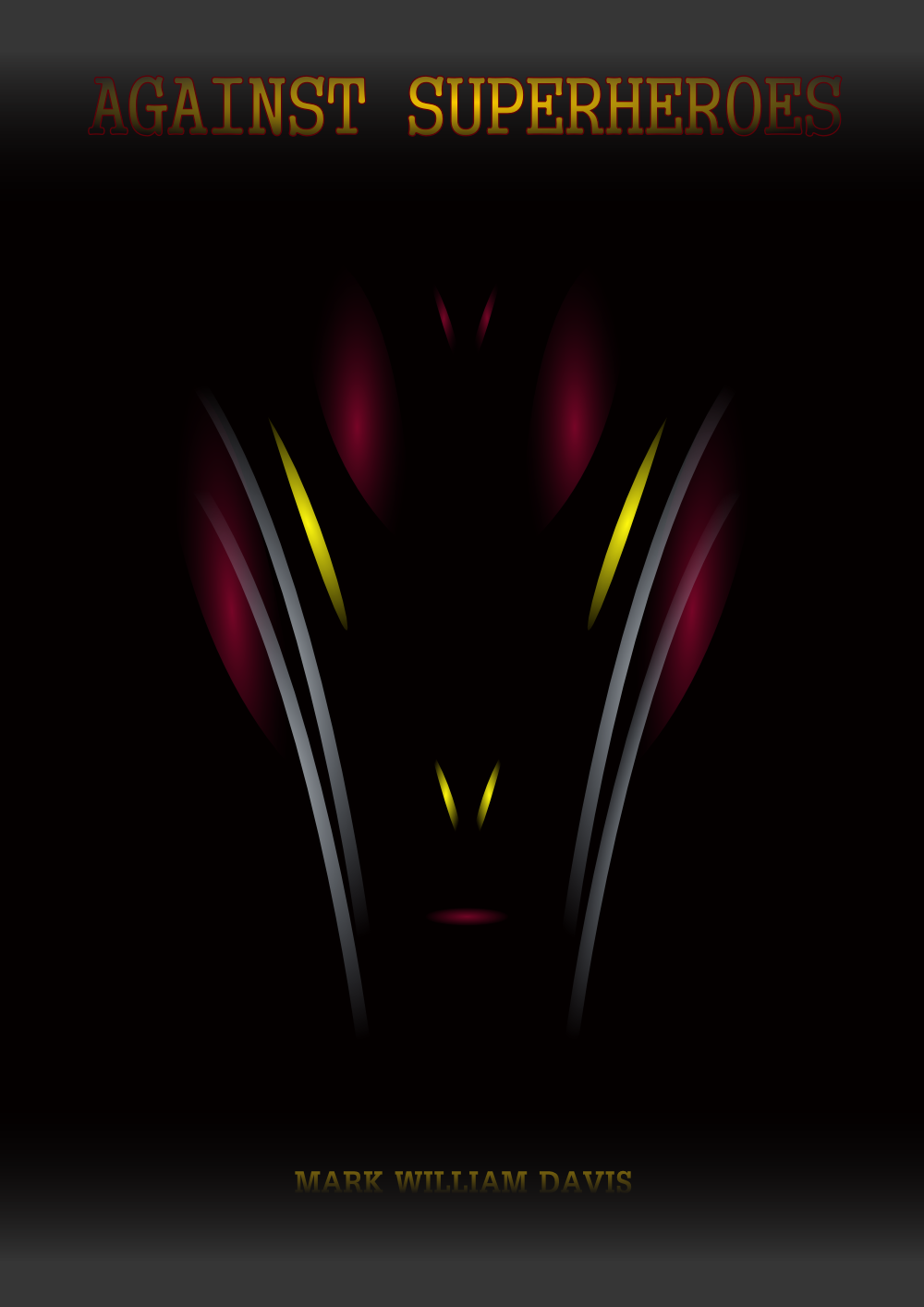
New sample cover art for Against Superheroes, available December 2015: