Signals and Noise: Chapter 9 (Trance: beginnings)

States of consciousness satisfy wildly different conceptions with equanimity. Here we have epiphenomenalism, where the feeling, the self, the I, are all freeloaders on some deeper commingling of logical prescriptions and mathematical calculations. We can stop right here, though, and track about in the cathedral of those subjective essences, reveling in each distorted recollection and episodic fumbling, worried that we are deflating the heart of the matter, the emotional character, draining out the seed that is essentially who we are. With time hanging like this—stopped, frozen—the propositions and their statistical basis functors start to rise into clarity, and the ripples of their influence trickle into sensibility. I did in fact do that, say that, because it did in fact make sense. I am aware of that now and the blip of clarity, momentary as it was, reflects that underlying matrix of contending feelings, driving hopes, and social posturing.

But here we have dualism, reflecting every folk psychological wire in our hypothetical soul. We are distinct and apart from our bodies, like parasites hitching a ride, implanted by some god or first principle back behind our brow ridge. Oh, yes, we are subjects of the body and brain, but we are also their master. We command, they obey, at least until they buck and collapse under duress, laziness, and pain. The signals come back in and there is not enough will, despite our separation behind the bunkered walls of gauges. There is not enough will, somehow, to push a bit further, because we are in fact the fatigue, the pain, the boredom. We realize this at those passing moments when we are at the limit and the structures seem too porous for there to be any reason to the proposition.… Read the rest
AntiTerran Metatextuality

Intertextuality is a loaded word. It covers allusion and parody and reference. For some authors, it is the motivation to write, from Umberto Eco’s semiotic indulgences to Nabokov’s vast, layered palimpsest in Ada. I create deliberate allusions to Genesis in Teleology and references to Nabokov’s Ada in Signals and Noise.

The opposite of intertextuality might be centrality or concreteness, but it might also be the extension of the literature or artwork as references in other works that extend or reimagine the original work, creating a literary chain of sorts. Your intertextual references are referenced by my metatextual extensions.  Outertextuality? Whatever the term, we get a kind of referential landscape like a network that builds on an artificial landscape, the lives of imagined characters, and the universe of ideas that they inhabit.

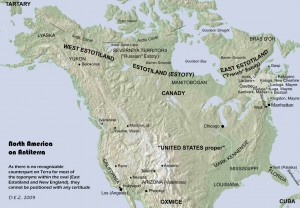
Dieter Zimmer, who appears to have done the German translation of Ada, has a brilliant example of metatextuality in his Geography of AntiTerra. With methodical precision, he translates the textual descriptions into a map of the imagined world–a kind of fan cartography that solidifies the strange geography into a complete realization. I’m reminded of the Elven dictionaries in The Silmarillion or the detailed online fan fiction from adoring readers of current bestsellers.

I think there is likely a strong connection between the psychology of religious belief and the same motivators towards metatextuality. Imagined worlds are always interesting and plotted. Even when characters are harmed or injured, we feel only fleeting sensitivity to the idea of their injury. Moreover, the intertextuality is a network of coherence-supplying support for the narrative’s epistemology. The more detail, the greater sense of clarity of the imagined world, and the more buy in as to the reality of mysteries described therein.… Read the rest