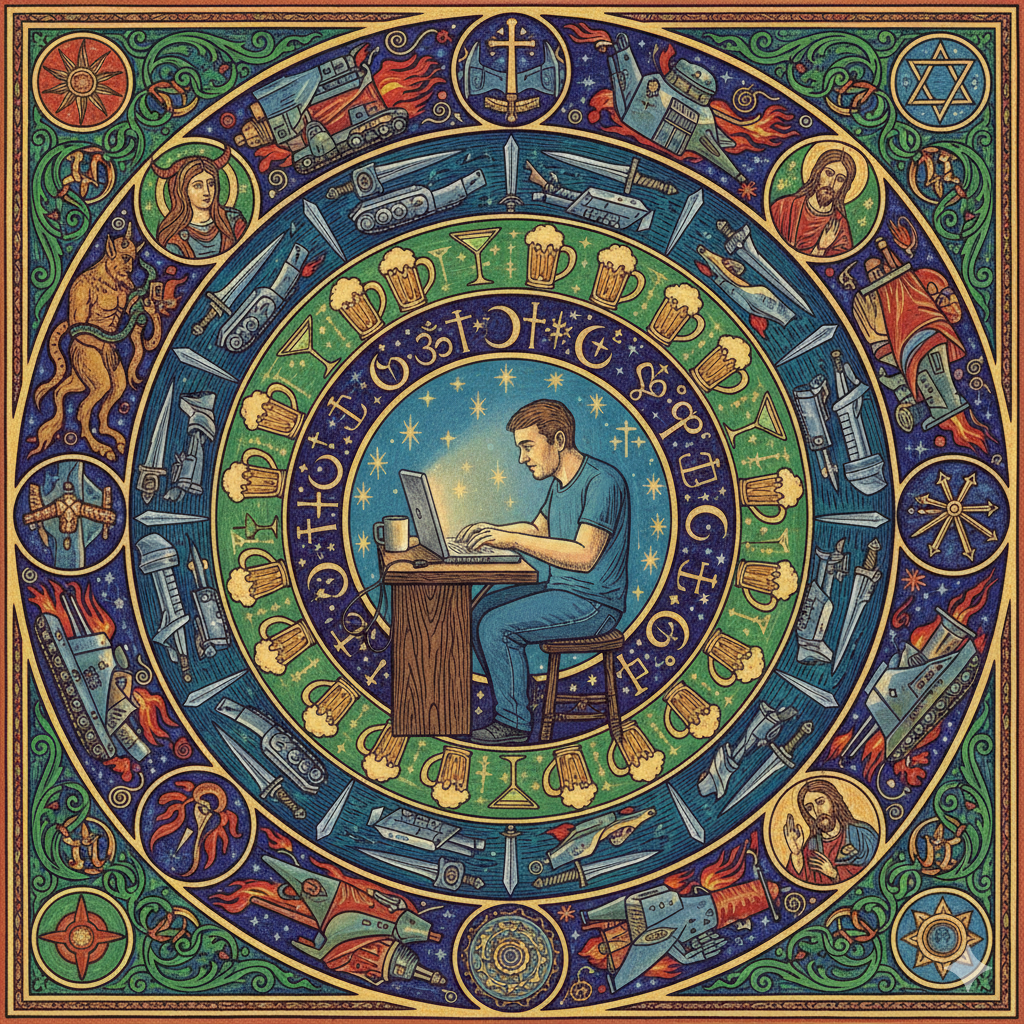
I like to critique intellectual history—more the armchair type than the academic varietal—because it often reflects the open biases of the commentator rather than having been developed by a neutral analysis of the past and its relationship to our pending futures. So when I read about Husserl’s ideas of geometry and Galileo or the relative merits of Adam Smith’s The Theory of Moral Sentiments, I leave the critical analysis to the experts, equipped as they are with the proper academic insights. But columnists are not generally subject-matter experts, just enthusiasts who are driven by profession to justify their insights and prognostications by reference to history and ideas. And they substitute biases for depth far too often. This is true again today, with Leighton Woodhouse’s op-ed in The New York Times, “Donald Trump: Pagan King.” It begins gently enough, with a quote by Canada’s Mark Carney from Thucydides about power in international relations, but then quickly dissolves into an unsupportable argument about how Christianity was uniquely civilizing of the pagan world by introducing all the positive morals that we associate with the gentler, humbler aspects of the religion, mostly on the back of a single source.
This through line is embarrassed by the theology, history, and facts of how Western civilization matured, as I and hundreds of other commentators pointed out (this chestnut is getting repetitive, too). This is not meant to rob Christianity of its influence in the last two thousand years, just to temper it responsibly and note that however one scopes “paganism,” Enlightenment rationality, high and low, shared aspects of pagan forms of thinking, and was clearly influenced by it as we move into the formative phase of the modern state period and formulations of democracy. Glad handing without confronting the countering facts minimizes the argument into a polemic, and polemics don’t rise to the level of intellectual history.
To justify a thesis that Christianity tempers the old pagan ideas of conquest and power with respect, kindness, and humility, an author needs to explain away the history of oppressive slavery, cruelty towards women, wars of religion, crusades, conquest, colonialism, conversion, pogroms, dehumanization of pagans, and opposition to intellectual advances and change that characterize much of that history. Just a casual re-examination finds Enlightenment values of rationality and science as leading, in turn, to innovation in governance and international relations, as well as deconstructing tribal and power relationships in favor of non-zero-sum systems that benefit greater and greater numbers of people while respecting their religious and ethnic differences.
Could pagan traditions have achieved the same outcome? We can’t know, which is the humility of pagan Socrates shining through the veil of uncertainty. Arguing otherwise is just speculation and polemic in the service of writing something that may swell the chest of believers, pagan, Christian, or otherwise, rather than address the fragility of the history and methods we rely on to parse out the grammar of where we are now.
Ross Douthat constantly tries similar approaches, as he did recently when theorizing about various vices in modern America and how those might be related to libertarianism and liberalism. He has an abstract problem with people being too free and not engaging in the self-control that might come along with religious belief. The fallback is to legally regulate life more since people are too flawed to coexist with temptations like gambling and pot. The historical reflections win the day, if not the unwritten next decades, with notes about three-martini-lunches and the Roaring Twenties, hippie life, cocaine-laced soft drinks, and opioid patent medicines in our gloriously messy American past. This country or world of self-control and passion channeled only to positive devotion or engagement is hard to find, though one might cite the happiness of the Mormons or the Finns as something worth regarding, though they diverge mightily in the sources of their well being.
Alas, columnists need to write about something by winding arguments tightly around their theses. I have the luxury of just unraveling them while I wait for new details that might substantiate intellectual histories. I suppose this is a worthwhile pastime for all of us, but I would love to walk through compact, well-supported idea architectures of exquisite novelty now and again. The landscape seems rather sparse these days, but perhaps the deafening shriek of politics is interfering with the quality of the products.