Most interesting menu thusfar…beats French Laundry and Chez Panisse. Best of all, not being able to read the menu heightened the drama. Special thanks to my hosts on the eve of their tragic anniversary.
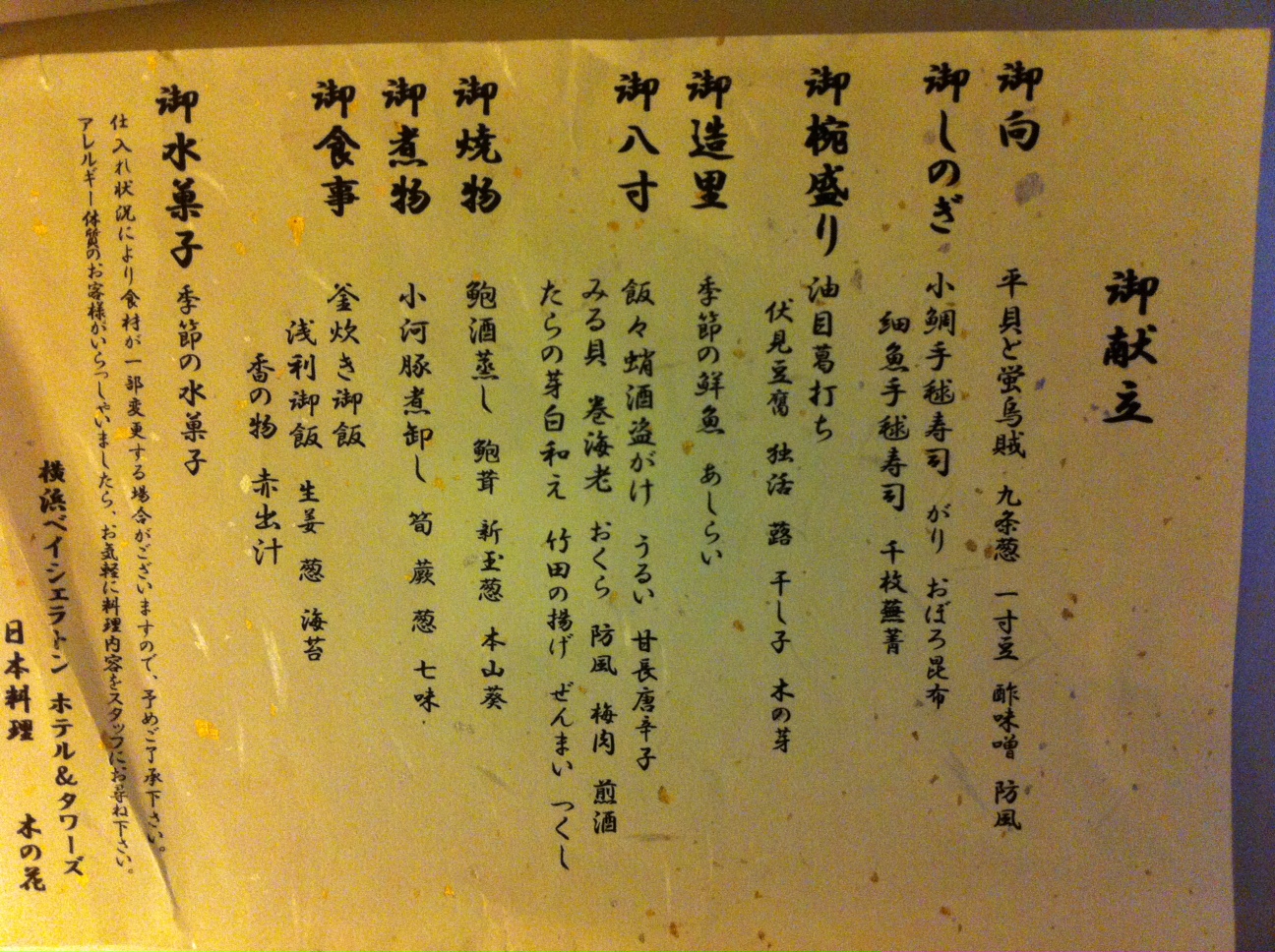
Most interesting menu thusfar…beats French Laundry and Chez Panisse. Best of all, not being able to read the menu heightened the drama. Special thanks to my hosts on the eve of their tragic anniversary.
 Sometimes, when Zach had too much coffee, when he had sneaked a smoke on the back porch that projects out over the weedy ground and right up to the back wall, beyond which is the alley and driveway of an apartment complex in drab rose and orange, sometimes he would lie awake until there was a subtle shift in his sensibilities that was almost like a buzz encompassing him, and he would go on thinking about the events of the day even as he drifted off to sleep and then awoke again, minutes later, and was still thinking about them, like an unbroken chain of reasoning that suffered a momentary dip. But there was always a specter hanging in the facts and the faces and the ideas, like an irrational interloper. Only a fever ever reproduced anything like those moments—like that specter—only a fever could twist ideas over themselves into the impossible and weird motifs that were a merger of sleep and waking fantasies. Zach would rouse in those moments or sometimes bolt upright while trying to reclaim the ideas and force them into a coherent whole, but then, when the pieces had regained their permanence and the puzzle was reunited and showed, once again, the rational and calm artwork on the box of everyday reality, Zach would find himself longing for that alternative state, for the confusion that he struggled to subdue in the hypnagogic fog. It was not just curiosity, he realized, but a sense that there was a constructive event surfacing out of his unconscious self—an event that was using his memories for some special purpose.
There was an ameliorative effect to the anxieties of the day that crept in at those moments, like a sieve had strained all the complexity out of the bursts of nervous arousal, and he would lean back again into the hollow of his down pillow that smelled like his hair, tinged by his shampoo, and turn his face into the dome, sliding his cheek against the silky weave of the pillowcase, finally thinking that sleep would arrive soon.… Read the rest
 States of consciousness satisfy wildly different conceptions with equanimity. Here we have epiphenomenalism, where the feeling, the self, the I, are all freeloaders on some deeper commingling of logical prescriptions and mathematical calculations. We can stop right here, though, and track about in the cathedral of those subjective essences, reveling in each distorted recollection and episodic fumbling, worried that we are deflating the heart of the matter, the emotional character, draining out the seed that is essentially who we are. With time hanging like this—stopped, frozen—the propositions and their statistical basis functors start to rise into clarity, and the ripples of their influence trickle into sensibility. I did in fact do that, say that, because it did in fact make sense. I am aware of that now and the blip of clarity, momentary as it was, reflects that underlying matrix of contending feelings, driving hopes, and social posturing.
But here we have dualism, reflecting every folk psychological wire in our hypothetical soul. We are distinct and apart from our bodies, like parasites hitching a ride, implanted by some god or first principle back behind our brow ridge. Oh, yes, we are subjects of the body and brain, but we are also their master. We command, they obey, at least until they buck and collapse under duress, laziness, and pain. The signals come back in and there is not enough will, despite our separation behind the bunkered walls of gauges. There is not enough will, somehow, to push a bit further, because we are in fact the fatigue, the pain, the boredom. We realize this at those passing moments when we are at the limit and the structures seem too porous for there to be any reason to the proposition.… Read the rest
Rooftop gardens, construction workers doing calisthenics before starting their labors, and a multi-tiered cemetery and temple are pierced by a Shinkansen (bullet train) in this panorama via iPhone (Limit Point Software panorama app) and Gimp.… Read the rest
Since I’m in Japan, it’s raining and I slept too much on the plane to get back to sleep, I thought I’d post on the Japanese blood type craze. Full disclosure, as AB+ I can be arty and mysterious.
I’m reminded of the suggestion that UFOs are demons that permeates some of more extreme fundamentalist community. In the case of the Japanese interest, it likely started from origins in “scientific racism” that permeated pre-WWII Japan and Germany. Quoting Mussolini, “The best blood will at some time get into a fool or a mosquito,” I have to wonder how the Axis powers managed their racial antipathy towards one another enough to remain part of the Axis?… Read the rest
 Intertextuality is a loaded word. It covers allusion and parody and reference. For some authors, it is the motivation to write, from Umberto Eco’s semiotic indulgences to Nabokov’s vast, layered palimpsest in Ada. I create deliberate allusions to Genesis in Teleology and references to Nabokov’s Ada in Signals and Noise.
The opposite of intertextuality might be centrality or concreteness, but it might also be the extension of the literature or artwork as references in other works that extend or reimagine the original work, creating a literary chain of sorts. Your intertextual references are referenced by my metatextual extensions. Outertextuality? Whatever the term, we get a kind of referential landscape like a network that builds on an artificial landscape, the lives of imagined characters, and the universe of ideas that they inhabit.
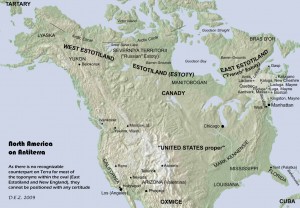
Dieter Zimmer, who appears to have done the German translation of Ada, has a brilliant example of metatextuality in his Geography of AntiTerra. With methodical precision, he translates the textual descriptions into a map of the imagined world–a kind of fan cartography that solidifies the strange geography into a complete realization. I’m reminded of the Elven dictionaries in The Silmarillion or the detailed online fan fiction from adoring readers of current bestsellers.
I think there is likely a strong connection between the psychology of religious belief and the same motivators towards metatextuality. Imagined worlds are always interesting and plotted. Even when characters are harmed or injured, we feel only fleeting sensitivity to the idea of their injury. Moreover, the intertextuality is a network of coherence-supplying support for the narrative’s epistemology. The more detail, the greater sense of clarity of the imagined world, and the more buy in as to the reality of mysteries described therein.… Read the rest
Adam Gopnik’s exceptional review of Elaine Pagels’ new book on The Book of Revelations in The New Yorker brings the complexity of the early 1st Millenium into stark focus. Were the Pauline tracts aberrant and Revelations an attempt to turn early Christianity back from Gentile contamination? Why was the book so controversial and the early Christian world filled with so many heresies? Arianism, Sethianism, Valentianism, and the list goes on and on…only to be resolved by political wrangling and ecumenical councils.
Noteworthy is Pagels’ inclusion of discussion of the Nag Hammadi poem, Thunder, Perfect Mind. Gopnik points us to a Ridley Scott commercial for Prada that includes a reading of it:
Thunder Perfect Mind – a Prada Film starring Daria Werbowy from M G on Vimeo.
Also notable is that the model uses some cherry picking of the poem content. “I am the whore and the holy one” probably has the wrong resonance for a Prada perfume. From mystic revelation to luxury goods…as astonishing a journey as The Book of Revelations.… Read the rest
Toby Ord of Giving What We Can has other interests, including ones that connect back to Solomonoff inference and algorithmic information theory. Specifically, Ord worked earlier on topics related to hypercomputation or, more simply put, the notion that there may be computational systems that exceed the capabilities of Turing Machines.
Turing Machines are abstract computers that can compute logical functions, but the question that has dominated theoretical computer science is what is computable and what is incomputable. The Kolmogorov Complexity of a string is the minimal specification needed to compute the string given a certain computational specification (a program). And the Kolmogorov Complexity is incomputable. Yet, a compact representation is a minimalist model that can, in turn, lead to optimal future prediction of the underlying generator.
Wouldn’t it be astonishing if there were, in fact, computational systems that exceeded the limits of computability? That’s what Ord’s work set-out to investigate, though there have been detractors.… Read the rest
 LukeProg interviews Toby Ord of Oxford and founder of Giving What We Can about what may be an even more complex problem than that of the Existential dilemma over being itself: how do we overcome uncertainty in formulating an ethical system?
Conversations from the Pale Blue Dot: Toby Ord
There are few definitive answers, of course. How could there be? But Toby does a great job of drawing a map of deontological theories (rule-based, including “divine command theory”), virtue ethics, and consequentialist theories (utilitarianism, etc.). He’s partial to the latter (and even thinks most of the ethical systems might be unified as consquentialist), and his foundation has worked to perfect the calculations concerning how an individual’s contributions to specific charities can potentially result in the future reduction in human suffering.
Here’s a quandary, though: is exuberant excess sometimes necessary for enhancing future productivity that might lead to greater reductions in human suffering? I may just be hoping to justify my failure to follow Toby’s example or, at least, to make up for it later in life.… Read the rest
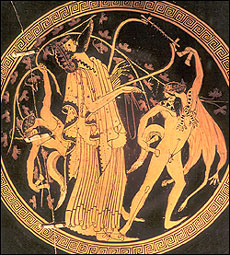
I was, somewhat ironically, concocting salmon risotto with a drizzle of white wine while my wife read to me about Etruscan mythology from Wikipedia this evening. From Seneca the Younger:
Whereas we believe lightning to be released as a result of the collision of clouds, they believe that the clouds collide so as to release lightning: for as they attribute all to deity, they are led to believe not that things have a meaning insofar as they occur, but rather that they occur because they must have a meaning.
Last year we had the opportunity to visit the National Etruscan Museum in Rome during the most unbearably tropical European summer in recent memory.
Seneca the Younger somewhat snidely detected a difference, driven at least partially by a feeling of cultural dominance, that teleological explanations are inferior to naturalistic ones, that one more entity (or a host of them) provides no additional value to the explanatory system.… Read the rest