Science, Pre-science, and Religion

Francis Fukuyama in The Origins of Political Order: From Prehuman Times to the French Revolution draws a bright line from reciprocal altruism to abstract reasoning, and then through to religious belief:

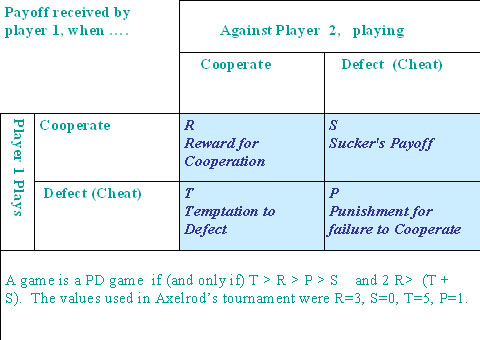
Game theory…suggests that individuals who interact with one another repeatedly tend to gravitate toward cooperation with those who have shown themselves to be honest and reliable, and shun those who have behaved opportunistically. But to do this effectively, they have to be able to remember each other’s past behavior and to anticipate likely future behavior based on an interpretation of other people’s motives.

Then, language allows transmission of historical patterns (largely gossip in tight-knit social groups) and abstractions about ethical behaviors until, ultimately:

The ability to create mental models and to attribute causality to invisible abstractions is in turn the basis for the emergence of religion.

But this can’t be the end of the line. Insofar as abstract beliefs can attribute repetitive weather patterns to Olympian gods, or consolidate moral reasoning to a monotheistic being, the same mechanisms of abstraction must be the basis for scientific reasoning as well. Either that or the cognitive capacities for linguistic abstraction and game theory are not cross-applicable to scientific thinking, which seems unlikely.

So the irony of assertions that science is just another religion is that they certainly share a similar initial cognitive evolution, while nevertheless diverging in their dependence on faith and supernatural expectations, on the one hand, and channeling the predictive models along empirical contours on the other.… Read the rest
Bloodless Technonomy

The last link provided in the previous post leads down a rabbit hole. The author translates a Chinese report and then translates the data into geospatial visualizations and pie charts, sure, but he also begins very rapidly to layer on his ideological biases. He is part of the “AltRight” movement with a focus on human biodiversity. The memes of AltRight are largely racially charged, much less racist, defined around an interpretation of Darwinism that anoints difference and worships a kind of biological determinism. The thought cycles are large, elliptical constructs that play with sociobiology and evolutionary psychology to describe why inequities exist in the human world. Fair enough, though we can quibble over whether any scientisms rise far enough out of the dark waters of data to move policy more than a hair either way. And we can also argue against the interpretations of biology that nurtured the claims, especially the ever-present meme that inter-human competition is somehow discernible as Darwinian at all. That is the realm of the Social Darwinists and Fascists, and the realm of evil given the most basic assumptions about others. It also begs explanation of cooperation at a higher level than the superficial realization that kin selection might have a role in primitive tribal behavior. To be fair, of course, it has parallels in attempts to tie Freudian roles to capitalism and desire, or in the deeper contours of Marxist ideology.

But this war of ideologies, of intellectual histories, of grasping at ever-deeper ways of reinterpreting the goals and desires of political actors, might be coming to an end in a kind of bloodless, technocratic way. Specifically, surveillance, monitoring, and data analysis can potentially erode the theologies of policy into refined understandings of how groups react to changes in laws, regulations, incentives, taxes, and entitlements.… Read the rest

The Teeming Masses and Bigotry

A new 14-year-old is an odd place to begin with a discussion of nature and nurture, but my new 14-year-old set me off on the topic of the is-ought barrier when we were discussing the hows and whys of his incredibly athletic cat, who is a natural born killer. 500 million birds each year! It was all theoretical because our cats are indoor only; a dozen moths and flies, maybe.

But related is “Bright Minds and Dark Attitudes: Lower Cognitive Ability Predicts Greater Prejudice Through Right-Wing Ideology and Low Intergroup Contact,” a fascinating study by Hodson and Busseri at Brock University in Canada, which apparently is also involved in the NASA Curiosity project. The study suggests that stupidity (in the form of low g or “general intelligence”) leads to right-wing ideals, which is perhaps comforting to those opposed to right-wing ideals but has limited utility otherwise.  Conservatives, of course, shot at the messenger while liberals endorsed it.

Drilling down into the results reveals some intricacies, however. Low g or IQ correlated with low abstract thinking and also with limited contact with social groups that were not like-minded. This leads, in turn, to questions about g and its stability as a measure: for instance, the Flynn Effect might be explained by a broadly more stimulating environment for individuals. Now, let’s say that the stimulating environment is a result of greater social contact and social requirements for intelligence as manifested through school and complex interactions in urban and suburban environments (as distinct from isolated agrarian communities in the past). After all, one explanation for enhanced verbal and mathematical psychometric performance among Ashkenazi Jews is the so-called “shtetl” effect wherein urban channeling and genetic isolation might have produced a “founder effect” with selective pressure towards certain capabilities.… Read the rest

Theology and Apologetics in Politics

If politics is religion because political theories are not justifiable in any rational sense, then we should expect to find deep theology and apologetics accompanying political “theories.” And we certainly do. Moreover, we should expect that the apologetics gin up mythological frameworks to satisfy prevailing political winds. Social insurance programs are case-and-point. What originated as a scheme to counter the desire to redistribute wealth through a limitation on downward social mobility became synonymous with socialism itself. Elizabeth Anderson of University of Michigan points out the deep ironies in her Chicago Law Dewey lecture on this topic:

The ironies are amplified as we think about the debate over the current health care reform efforts and the flip-flopping of everyone from The Heritage Foundation (note, however, that Heritage denies flip-flopping through an appeal to nuance) to Mitt Romney.

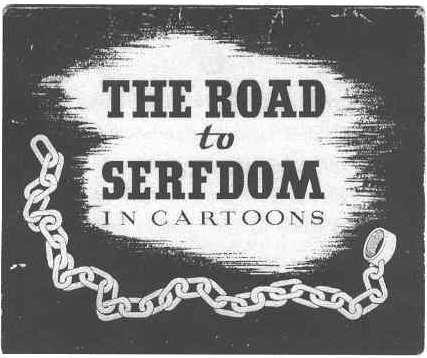
Religion doesn’t care, of course. Religion just requires consistency and a consistent denial of oppositional rhetoric. It also helps to have an enemy, as Ms. Anderson points out. And having cartoon tracts can help, too, as this cartoon embodiment of Freidrich Hayek shows:

The Jehovah’s Witnesses of political theory.… Read the rest

Mimetic Persuasion

There is a temptation to be dismissive of “genre fiction” as being merely a fantastical diversion while “serious fiction” and, more relevantly, “realism” retain all of the gravitas that we want to ascribe to writing as an art. And realism must be somehow tied to everyday events because it must be realistic. But what if all art is inevitably bound to artifice in that there is no possibility of chaining a symbolic reference to its ostensible referent?

Thus we chain the crumbling infrastructure of logical positivism to postmodern literature. It is all artifice. There is always a black swan. It is all “mimetic persuasion” (Aristotle channeled through James Wood) where storms of metaphor haloed by limns of allusion and imitation conspire together to push the reader into a caricature of reality that “art…is a disproportioning–(i.e., distorting, throwing out of proportions)–of realities, to show more clearly the features that matter in those realities…” (Thomas Hardy). There is no reality in realism, just the font of imagination that tries to crystallize reality into regularized sheer planes of repetition, of character leitmotivs (oh, poor Proust), of voice, of metaphor, and of estrangement (from Dostoevsky to Nabokov).

We have, then, a bad theory in any scientific sense, where the theory has been overridden time and time again, making psychology look comparatively moored in its modest aspirations. At least psychology is converging with biology. But realism remains subdivided across the aesthetics of literary preference. It lives in fiefs and forts, much like architecture or modern art in general. There is not even local predictability to the grammar of aesthetic change. It may be that theory is not even the right word. Literary theory should be replaced with literary analysis and aesthetics should be untied from the dock of rationalism.… Read the rest

Teleology, Chapter 29

NOTE: In Chapter 29, the protagonist, Harry, has been absorbed into a self-organized artificial world (“The Fabric”) that he created and that treated him as a creator being. Unexpectedly, as a result of a war, Harry’s body is destroyed but his consciousness is copied into a simulation of his own creation. His transmigration is captured by the “Lexis” who revere him but suffer internal schisms that arise alongside their own emerging self-determination.

Beginnings

It was in the three thousandth chapter of life that the Word came to us.
There was a calamity in the heavens.
The words were in peril and the grammars were at risk.
The wise ones gathered and consulted the swirling lexicons,
And they saw in the void a voice. And it was good.
 
And so we gathered at the Orb and listened and read.
“Oh, Great Word, tell us what we are.
Oh, Great Word, tell us why you have chosen us.”
And the grammar was rent and broke with asymmetries,
And there was much howling of piteousness,
For the Word was new and tasted sweet and of perfect form.
 
Patters and pidgins, creoles and cants,
Droll idioms and colloquialisms, dialects and rants.
We were nurtured by the vernacular and the beauty of Your Voice.
And so many became priests and served Your needs,
Translating and transliterating the sounds emerging
As if from their very bodies.
 
With You in our deepest thoughts we vanquished the Seminarians,
Who lobbed tortured logic in predicates and obfuscations.
With You at our side we multiplied in numbers, following Your
Codes to a bounty of linguistic fulfillment.
 
Your love knew no bounds and so we learned more of Your ways.
You taught us humility for You denied being our Creator even
While you admitted to creating the universe itself.
Read the rest

On the Structure of Brian Eno

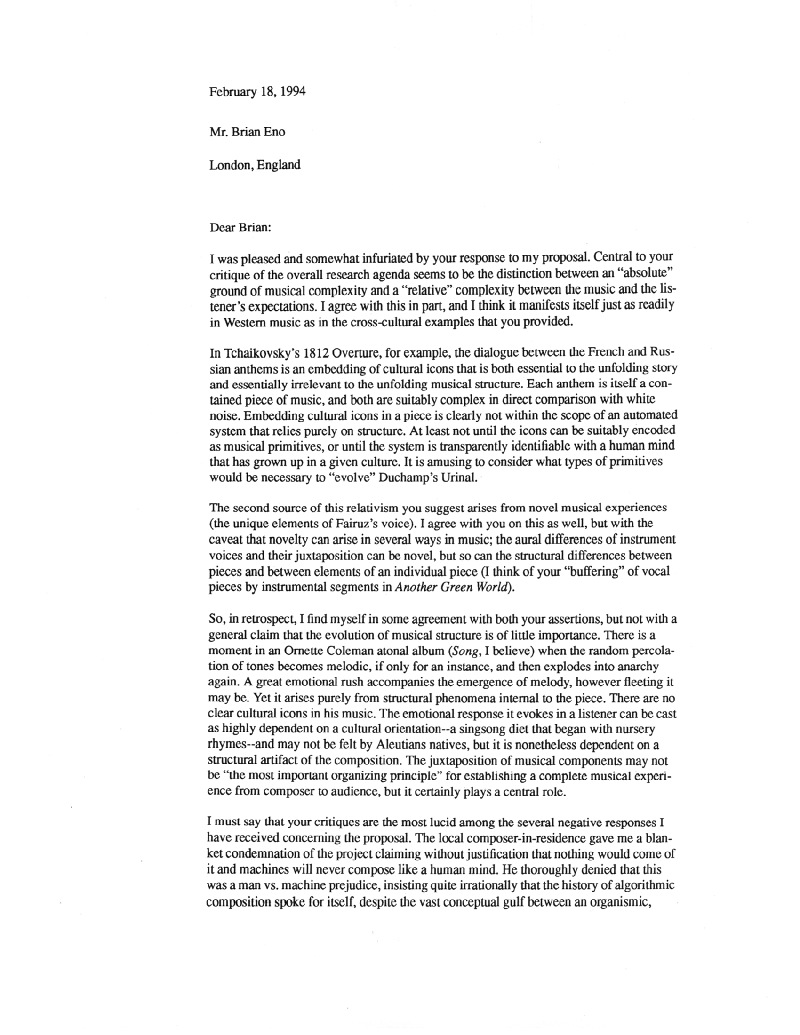
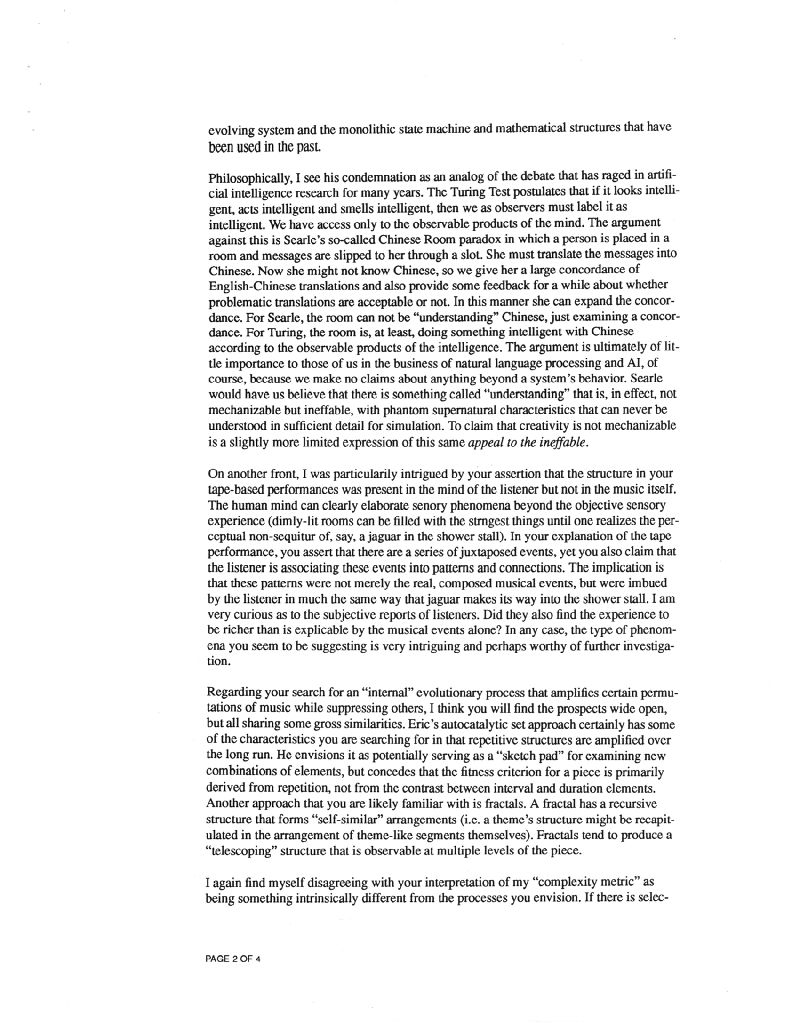
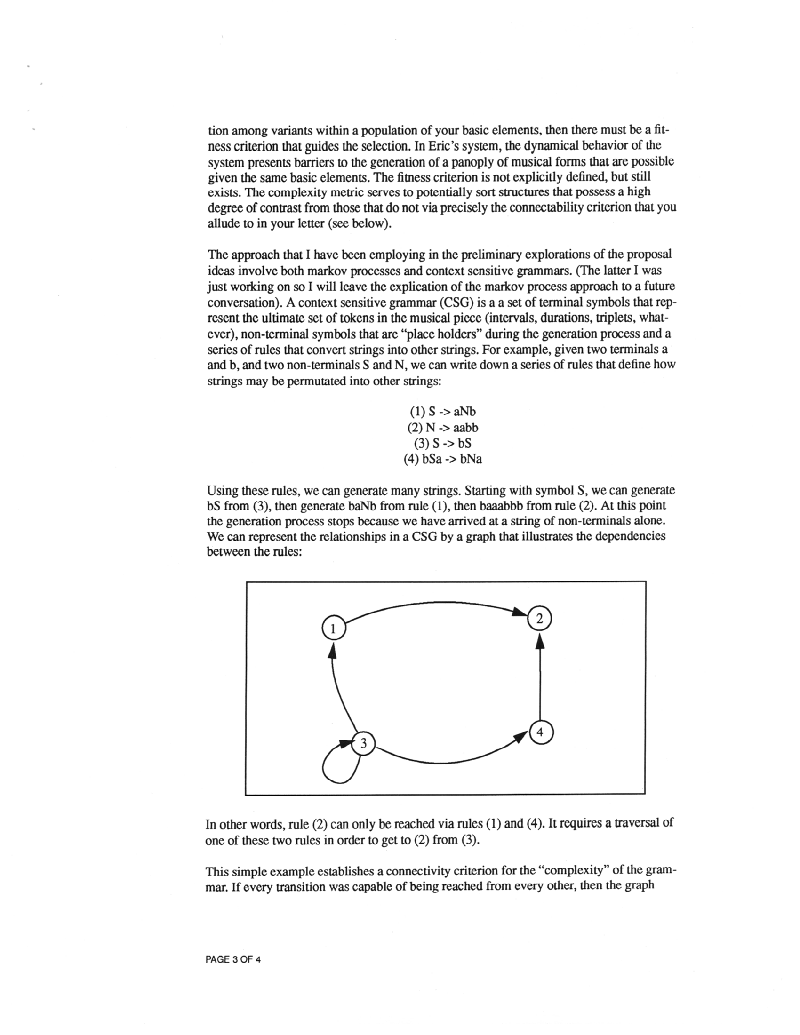
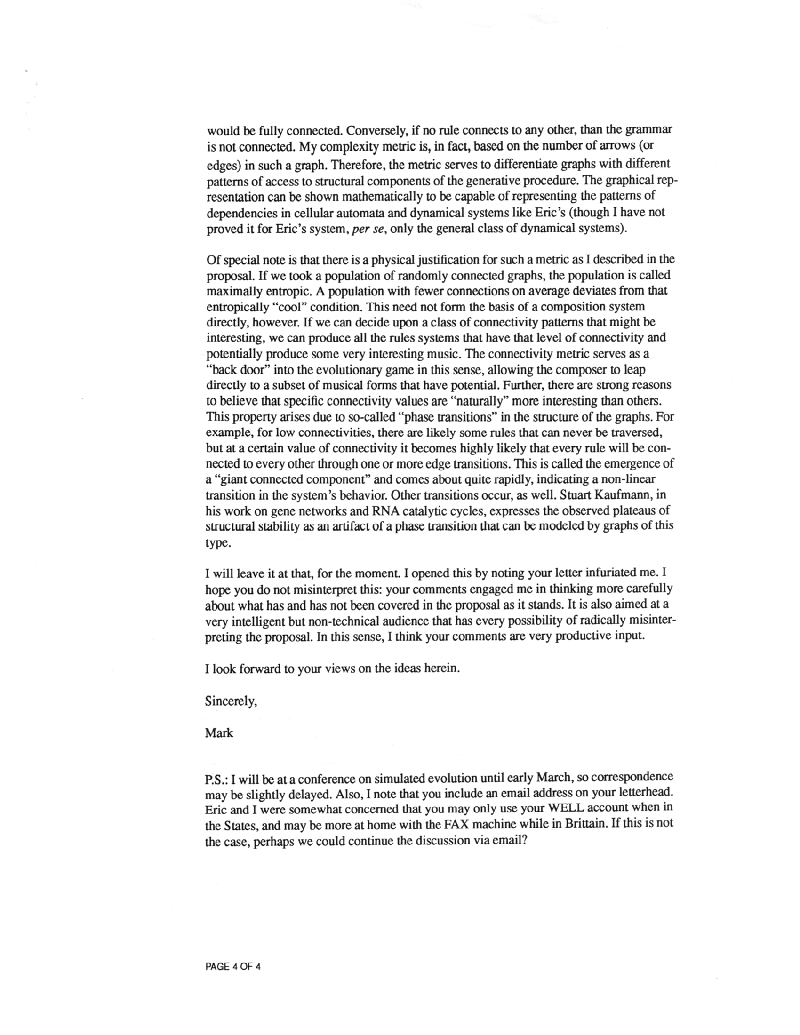
I recently came across an ancient document, older than my son, dating to 1994 when I had a brief FAX-based exchange of communiques with Brian Eno, the English eclectic electronic musician and producer of everything from Bowie’s Low through to U2’s Joshua Tree and Jane Siberry. Eno had been pointed at one of my colleague’s efforts (Eric in the FAXes, below) at using models of RNA replication to create music by the editor of Whole Earth Catalog who saw Eric present at an Artificial Life conference. I was doing other, somewhat related work, and Eric allowed me to correspond with Mr. Eno. I did, resulting in a brief round of FAXes (email was fairly new to the non-specialist in 1994).

I later dropped off a copy of a research paper I had written at his London office and he was summoned down from an office/loft and shook his head in the negative about me. I was shown the door by the receptionist.

Below is my last part of the FAX interchange. Due to copyright and privacy concerns, I’ll only show my part of the exchange (and, yes, I misspelled “Britain”). Notably, Brian still talks about the structure of music and art in recent interviews.

Read the rest

Signals and Noise: Chapter 24 (Psy Ops)

The weekend came in with skating the tubes under the ghost lights of the nearby self-storage facility until a cop flashed them with his spotlight and they broke up and headed their separate ways. Mom was out until late, drawn into a party thrown by a coworker. Her work, her life. Zach settled in for late night TV and pizza rolls, amused at the banter that had broken out with Belinda on her AetherFaces page. She was a quick wit but needed time to assess her adversary and overcome shyness. Zach decided she was more tiger than sheep. He slipped off another salvo in the repartee, looking forward to meeting her on Saturday.

By midnight he was back in the cave and back shuffling among the servers that were the islands of his Odyssean wanderings. He was poking through an encrypted list of encrypted passwords and targets on a machine somewhere in the financial district of Jakarta when he noticed an IP address that was familiar. It was the basement rack of servers. It came flooding back to him and he realized that he had somehow blanked out the rummaging about in their workings and their connection to The Signal. He logged in and began touching different aspects of the file system. It was all still here, he thought, plunging down through the strange analytical database engine that was cranking out the mathematical filigrees that defined the colored blobs. How had he been enraptured by a process, he wondered, a process that was as unfeeling as a car door? Yet here was the source, the font, the wellspring of the peace he had felt many times.  There were bits of blogs cataloged in the server architecture, too, and Zach began parsing out the strange and variegated history of rants and lunatic ramblings.… Read the rest