 Intertextuality is a loaded word. It covers allusion and parody and reference. For some authors, it is the motivation to write, from Umberto Eco’s semiotic indulgences to Nabokov’s vast, layered palimpsest in Ada. I create deliberate allusions to Genesis in Teleology and references to Nabokov’s Ada in Signals and Noise.
The opposite of intertextuality might be centrality or concreteness, but it might also be the extension of the literature or artwork as references in other works that extend or reimagine the original work, creating a literary chain of sorts. Your intertextual references are referenced by my metatextual extensions. Outertextuality? Whatever the term, we get a kind of referential landscape like a network that builds on an artificial landscape, the lives of imagined characters, and the universe of ideas that they inhabit.
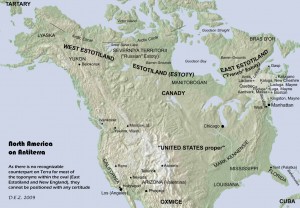
Dieter Zimmer, who appears to have done the German translation of Ada, has a brilliant example of metatextuality in his Geography of AntiTerra. With methodical precision, he translates the textual descriptions into a map of the imagined world–a kind of fan cartography that solidifies the strange geography into a complete realization. I’m reminded of the Elven dictionaries in The Silmarillion or the detailed online fan fiction from adoring readers of current bestsellers.
I think there is likely a strong connection between the psychology of religious belief and the same motivators towards metatextuality. Imagined worlds are always interesting and plotted. Even when characters are harmed or injured, we feel only fleeting sensitivity to the idea of their injury. Moreover, the intertextuality is a network of coherence-supplying support for the narrative’s epistemology. The more detail, the greater sense of clarity of the imagined world, and the more buy in as to the reality of mysteries described therein.… Read the rest